TheReference

  • Subscribe to our RSS feed.
  • Twitter
  • StumbleUpon
  • Reddit
  • Facebook
  • Digg
Showing posts with label religion. Show all posts

Tuesday, July 30, 2013

Salon: AGW cause confined to a left-wing ghetto

Posted on 1:28 PM by Unknown
Salon has reprinted an interesting sociological essay on the climate debate originally written by Geoff Dembicki for Canada's The Tyee:
How to talk to a conservative about climate change
Dembicki, a left-wing alarmist, starts by admitting that during the recent two decades, the climate worries have become increasingly confined to an intellectually sterile environment of brainwashed and stubborn people whose ideology strongly influences their very perception, something that Dembicki calls the "left-wing ghetto".


People not heavily invested into the left-wing ideology tend to reject the climate propaganda in the U.S., the U.K., and even in Canada. We're told something that folks like the Czech ex-president Václav Klaus have been saying for many and many years, namely that the purpose of the climate alarm isn't to care about the environment but to rebuild the human society.


We're shown examples of the differing moral compasses that the left-wing and right-wing people are using in decisions about questions. For example:
People who identify as politically liberal tend to have strong emotional reactions to questions of “care/harm” (protecting vulnerable elements of society) and “fairness/cheating” (making sure that justice is upheld).

Environmental arguments often evoke both. For instance: “Alberta oil sands firms are not held accountable (fairness/cheating) for their contribution to a warming climate that will ultimately harm the planet’s poorest people (care/harm).”

The logical left-wing reaction is to demand strict limits on oil sands emissions. But that climate change solution can provoke strong emotional reactions from people who identify as politically right-wing.

That’s because conservative morality tends to emphasize questions of “loyalty/betrayal” (staying true to your cultural group), “authority/subversion” (upholding long-held institutions) and “sanctity/degradation” (fending off defilement).

So the right-wing response to oil sands limits might be: “Since all Canadians benefit from our oil and gas industry (loyalty/betrayal), we shouldn’t restrict free markets (authority/subversion) to limit a naturally-occurring, odorless gas (sanctity/degradation).”
These are interesting thoughts and they're undoubtedly valid for most of the contexts but I would say that in this form, they just don't apply to your humble correspondent. While many have a good reason to count me as a rightwinger, my morality is actually closer to what is represented by the left-wing morality by Dembicki: I do care about "fairness/cheating" as well as "care/harm" more than about "authority/subversion" and "sanctity/degradation" (while I would probably disagree with most leftists on the question who and what needs to be protected, taken care of, and even what and who is vulnerable; and what is fair and what is cheating).


So Dembicki's precise description of the political correlations may only be accurate for the Anglo-Saxon world, and perhaps not the whole Anglo-Saxon world. The high correlation between Christianity and conservative politics is typical over there but this correlation is mostly worthless in my homeland (and, to a lesser extent, in other countries) where atheism is dominant on both sides.

In fact, the inaccuracies aren't confined to religion. It just happens that the most powerful self-described left-wing politicians in our country – such as the current president Miloš Zeman – also think that the global warming panic is a fabrication created by 2nd league politicians and activists. Proposals to "fight the climate change" would cost – and, to a smaller extent, have already cost – enormous amounts of money. Just yesterday, the Zeman-appointed non-partisan Rusnok government proposed to end the support for all renewable energy since 2014 (thanks, Soylent!): the proposed policy is called "stop a strop" (stop and ceiling): it stops for all projects not ended before 2014 and any increases of the support for existing projects. In economies of the right-wing type, this project would be paid from individual and well-defined corporate pockets; in economies of the left-wing type, this project would be paid from the shared coffers because most of the money is supposed to be in shared coffins. But it's a waste of money in both cases!

That's why at the end, I don't think that your answer to the question "Is it a great idea to waste trillions of dollars for this non-existent problem?" depends on whether or not you believe that people, peoples, and nations should share their assets and work. Of course, what increases your inclination to waste the money is the situation in which the money will be spent mostly from someone else's pockets – especially if you will actually be one of the rare profiteers who benefit (e.g. the parasites who are paid for the "climate change research").

Dembicki argues that people are always a bit irrational; information is rarely neutral; too much fearmongering is actually likely to increase the opposition to the panic; the green color has its limits. And without explicitly mentioning Al Gore's or James Hansen's or Michael Mann's names or the method ;-), he recommends the environmental activists to assassinate these three people because the messengers are often more important than the message and some messengers simply do a counterproductive job.

Another philosophical difference between left-wingers and right-wingers is mentioned by Dembicki: right-wingers mostly believe in the stability of the world and the justice, especially in the long run, while left-wingers don't. Even when it comes to this point, I am not so sure whether I am such a right-winger. I don't believe in an afterlife and justice on this side of the world is a very subtle thing. It often or mostly doesn't work and in all environments where it works much more often than dysfunctions, subtle work had to be done to achieve this state.

However, I obviously agree that the planet has been around for more than 4 billion years and it's a very long time. This long-term stability of the planet – and even of life on Earth – is an important general argument against pretty much all kinds of catastrophic scenarios (but just to be sure, I wouldn't endorse the general thesis that the life in the next centuries is guaranteed to survive any test; it's just very unlikely that a random threat you invent could be existential and the specific ones that have been hyped can be shown in detail not to be existential). So people who are more familiar with geology etc. are more likely to figure out that the climate fearmongering is pseudoscientific in character.

But as soon as you start to think about Dembicki's correlation between the climate panic and this piece of knowledge, you should realize that something strange is going on. What do I mean? Well, it should be the left-wingers who appreciate the longevity of the world, cosmology, geology, Darwin's evolution, and all that, and who also look at the Earth through the "Copernican" or "cosmic" lenses – we're a genetically garden-variety species on a mediocre planet orbiting an average star in a rank-and-file galaxy. The right-wingers are those who routinely believe in a Young Earth, who often reduce the history of the world to the history of the civilization in recent six millennia (a history that is full of exceptions), and who imagine the scheme of the world to be focused on the humans and their interests. At least this is the caricature of the narrow-minded right-wingers that the left-wingers love to present – and just to be sure, they pretend that they aren't talking just about the most deeply believing Christians.

So how did it happen that it's the left-wingers who are suddenly ignorant (and expected to be ignorant) about the longevity of the Earth, the negligible magnitude of the recent changes of the temperature and other environmental parameters relatively to the geological record, and the tiny percentage of mass that the CO2 makes in the atmosphere, that the atmosphere makes in the Earth, that the Earth makes in the Solar System, that the Solar System occupies in the Milky Way, and that our galaxy represents in the Universe?

The people believing in the climate hysteria have become so irrational about so many things that they're ready to abandon certain beliefs even if they represent the foundations of what they have been previously saying about the essence of the world for many decades! When you think about it, what really matters isn't whether they are left-wing or right-wing. What matters is that they are obsessed by this particular incoherent network of implausible assertions about the man-made carbon dioxide, the climate, and the hypothetical consequences of tiny changes of the temperature that may occur. The alarmists' opinions don't really have to agree with their scientific knowledge; they don't have to agree with the most general philosophical framework that they used to hold dear. This harmony isn't necessary because they have switched to the climate hysteria as the new #1 foundation of their belief system. The climate orthodoxy has become as important for them as the Islamic terrorists' reading of the Quran is for these terrorists. Everything else is secondary.

Almost all the climate alarmists are left-wing simply because the major left-wing belief systems have been rebuilt into the climate alarmist belief system more thoroughly than any right-wing belief system. More or less everything that Marxists, Maoists, and similar groups used to care about has been superseded by a good enough (for them) "replacement component" in the ideology of climatism which is why they don't think they're losing anything by switching. On the other hand, no version of climate alarmism has been reorganized and presented as a v2 version of Christianity or Hayekism or any other right-wing ideology. Even if you managed to invent a climatism that is meant to resemble a right-wing ideology, it couldn't lead to results that would be satisfactory for the left-wing climate alarmists. Why? Because for the hypothetical right-wing climatism to be really acceptable to right-wingers, it would have to fundamentally differ in certain respects and these differences would make the left-wing alarmists hate the new "right-wing alarmists" at least as much as the left-wing alarmists hate the climate realists in the real world. The real problem is that Marxism may be smelled in pretty much every paragraph of the actual climate alarmism we know. The real-world climate alarmism as we know it is a mutation of socialism or Marxism. Climate alarmism is just an environmentally sounding name but the detailed content of the package you buy with it is a reorganized socialism or Marxism. And socialism or Marxism, however reorganized, can't ever be happy with people who realize that these ideologies are pernicious, whether or not these people use climatic labels for themselves. That's why the left-wingers have murdered tens of millions of decent people and they're always ready to do it again.

Dembicki is right that most people accept or reject various claims about the climate debate according to their political affiliation. But he heavily oversimplifies what these political pressures are; strongly underestimates the easy-to-understand egotist, economic, and societal interests that actually turn most of the slight majority of the left-wing Academia (and similar groups) to supporters of this pathological ideology; and he also completely overlooks the people who should matter most if the debate were sensible – those who actually study these questions as impartially and honestly as they can. By implicitly assuming that those de facto don't exist, he implicitly admits that he doesn't belong to this honest group himself.

But many skeptics – I am not ready to say most skeptics but I insist that it is many skeptics – surely do belong to this group. These people know how to separate the scientific questions from the political ones and so on and how to rationally answer most of the questions that are relevant. The conclusion that these people end up with is that it is insane to try to "fight the climate change" by regulating the carbon dioxide.
Read More
Posted in climate, religion, science and society | No comments

Sunday, July 14, 2013

Origin of the name Motl

Posted on 10:59 PM by Unknown
When I was a baby, my father would often say that we come a French aristocratic dynasty de Motl – for some time, I tended to buy it ;-). Much later, I knew about the Yiddish (extreme Jewish dialect of German) novel Motl der Operator and people would conjecture that I must have some Jewish roots which I never believed.

Finally, I accidentally asked my editor, Ms Věra Amelová, who was just working on the index for the 2nd edition of the Czech Elegant Universe and who found an explanation of the origin in a book. I don't expect regular TRF readers to be interested in similar linguistic stuff but those who search for things using search engines may be interested. And I just wanted to write it down somewhere.


Doc. (Assoc. Prof.) Josef Beneš spent his life by his work on the origin of surnames. What does it say?


Motl or Mottl: a German [close to Pilsen] vernacular (dialect) form of the Czech surname Mátl [an actor is called this way]. The name Mátl itself came from Matas which was derived from the first name Matouš or Matěj [Matthew] which arose from Hebrew Matityahu, meaning a gift of God.

[LM: Amusingly enough, in recent discussions with a nice and versatile physics professor in Santa Barbara, I was led to find out – among many other things – that the name Baghdad may paradoxically have Slavic roots and it means a gift of God, too. "Bag" is related to "Bog", a Slavic word for God, while "Dad" or more precisely "dát" is "to give" in Czech and similarly in other languages.]

Alternatively:

Motlík [little Motl], Motloch [a derivative of Motl resembling brloh, a den] – a confused, deranged person in the Lachei, North Moravian/Silesian dialect of Czech [very far from Pilsen]. [LM: the Czech verb "motat" is probably related and it means wind, roll, reel, spool, but more relevantly totter, stagger, walk unsteadily, confuse, mix up, and – most importantly – muddle.]

You can pick your theory. My editor believes that the former, German, gift-of-God theory is much more likely to be the right one, both due to the more precise form of the name, the geographic proximity, as well as the tendency to obscure vowels in the Southern part of the Czech-German border region.

I don't need to explain that Luboš is a Slavic name linked to love, viewed as derived from more complicated names Luboslav and Lubomír but currently independent of them, often translated as "milý" i.e. dear, beloved, kind, nice, pleasant, likeable, agreeable, appealing, amiable, congenial, loved one, boyfriend, beau, gentle-mannered – you knew that, they're 14 most often adjectives that people immediately think about when my name is pronounced anywhere. ;-)

The link in the previous paragraph contains the list of 8 famous holders of the name. Do you know at least one of them? ;-) It also says that 22,700 holders of this first name in Czechia make it the 44th most frequent masculine one. To compare, there are about 800 male Motls in Czechia written in this exact way.

What about your name?
Read More
Posted in Czechoslovakia, religion | No comments

Tuesday, June 25, 2013

Should and could science act as a religion?

Posted on 10:58 PM by Unknown
Sabine Hossenfelder wrote an interesting essay that I mostly sympathize with:
Science should be more like religion
First, she believes that the 21st century is the century of the death of religions and the completion of the scientific revolution. This comment – many of us could say an optimistic comment – sounds so 1960s. If visions such as Eurabia become reality, the 21st century will mark the demise of the scientific attitudes and the return to the medieval superstitions, at least on the Old Continent.


Second, she concisely summarizes and exemplifies some qualitative differences between science and religion.

Third, she tells us that many people tend to ignore religions' commonalities with science and benefits they bring. I totally agree with that. Science and religion differ in some important ways but they still share some roots linked to the the human emotions, amazement, and curiosity – things that make us more precious than most animals. And aside from things that directly contradict science, religion also says many things that may have helped the human societies and that don't contradict science.

Fourth, it turns out that Sabine's most important inspiration that religions may offer to the scientists is a tool that should speed up her expected completion of the scientific revolution and the death of the religions: the effortless methods by which religions have penetrated and still penetrate into billions of minds. Sabine says that scientists should learn to become good speakers and preachers who are not dissimilar to the most captivating priests.

It's perhaps a nice and intriguing plan. It may also be a counterproductive or impossible one. Which adjectives are right? ;-)


While my attitude to religions has never been downright hostile – like my attitude to leftwingers, anti-string crackpots, and several other groups – I have never been meaningfully religious in any sense. But for decades, I have been noticing certain advantages that the religious people enjoy in the society.

Centuries ago, they had the right to burn an ideologically inconvenient person at stake – as a heretic. This special right has pretty much survived in numerous countries of the Islamic Anticivilization. Even in democratic countries, religions of various kinds enjoy some protection of a sort.

In many countries, you may even face trouble if you mention that Jesus Christ may have been an ordinary person or ħe didn't exist at all. Or if you inform anyone that Mohammed was a jerk who was sleeping with underaged girls that made Silvio's Berlusconi Ruby the Heartstealer a mature woman in comparison. (Poor Silvio got 7 years.)


But even the freedom to talk about "less personal" aspects of science and religion may be restricted in various otherwise civilized countries because such a freedom could clash with the sensibilities of the religious folks. I have always been amazed that the scientific "belief system" has never enjoyed a similar kind of protection.

Now, the science ends up with many conclusions that differ from the axioms of religions. More importantly, it has a very different methodology how the truth is being chosen from the candidate truths. But from some viewpoint, these are technicalities. What may be more important is that science may be – and should be – taken as seriously as religious people see religions and their teachings.

To be personal, let me mention that just like a Christian may be offended when he hears some unpleasant stories about Jesus Christ, I am offended when I hear people saying dismissive things about quantum mechanics, relativity, string theory, or some other important portion of science. I would surely like most of these folks to be burned at stake if there were a humane and acceptable infrastructure for such things. ;-)

But scientific gems aren't being defended in this way. Lawmakers etc. seem to believe that only lies, superstitions, and similar trash need to be protected. The actual truth doesn't need to be protected, the consensus seems to say. I just happen to disagree. Note that while science has followed a completely different methodology to reach its conclusions about the truth, we have a much greater confidence in many of its conclusions than religious people should have in any of the pillars of their faith. But the prevailing opinion seems to be that the scientific truth doesn't deserve the protection.

Why is that? The methodology with which science finds its truths is different from the methodology of religions. Of course that I think that the scientific method is superior just like the religious people may think that the religious method is superior. I have already proposed to treat these differences as technicalities. Science and religions also follow different kinds of "spiritual leaders". While science marches in the footsteps of some of the smartest, most hard-working, educated, sometimes modest, sometimes self-confident, but uniformly curious people such as Albert Einstein, religions get inspired by a mixture of folks of many types with an important flavor added by loud bigots, mass killers, morons, and power-thirsty demagogues. Maybe this difference between the leaders is why the societies think that it's OK to insult scientific insights but not the religious sensibilities? Only jerks and their mindless bootlickers need some protection, right?

But I didn't really want to write a text suggesting that everything is bad about religions because I don't really believe so. My main point is different: I am frustrated by the fact that the immense wisdom that science has brought to the mankind – including the journey that has led to the insights (and that will lead to new insights in the future) itself – isn't passionately believed to be a set of precious gems that deserve to be worshiped. Almost no one seems to be passionate about science. Almost whenever I see someone talking about science to a broader group, soon or later (usually very early!) I have to witness a sourball who really hates science and finds it boring and despicable. Almost every layman thinks that any talk about science is a reason for frustration, something we should emit poisonous words about. It's literally everywhere.

Yesterday, I watched an interview with Lisa Randall. The host asked (here) whether it was true that – as he understands it – the extra dimensions are just some boring refined junk that science chooses to study because the simpler kinds of junk have already been thrown in the trash bin. Yes, this is what extra dimensions – or at least every genuine scientific theory that surpasses its less accurate and less complete predecessors (something we can't reliably say about the extra dimensions yet) – exactly is. And this is why it is so magnificently glorious. This is what science is all about. Science is all about finding ever better theories that succeed where their previously triumphant predecessors failed.

Perhaps we have gotten used to the fact that we can't crucify the host for his staggering blasphemy. But it's worse than that. There doesn't even seem to be a consensus that by this dismissive talk about the most universal essence, spirit, and indeed the very point of science, he is proving himself to be a completely uneducated, uncultural imbecile. Why? Do all the people really misunderstand that he is an imbecile or is there just some suffocating atmosphere in the society that tells us that we shouldn't even say these self-evident things?

You may rightfully object that I should have avoided these morally colored comments because the actual reason why people are this dismissive about science and its insights is not their being immoral; it's simply their being stupid. They can try to learn something but there are certain innate limitations that can't be surpassed and the missing desire to actually understand science is the ultimate reason why they will remain ignorant and unexcited, even about fundamental questions.

And that's the main reason why I tend to think that this whole dream about a religion-resembling, science-worshiping community of billions of people is a mirage. (It took me a few years to understand that not even scientology was the science-based church I was looking for.) There simply don't exist billions of people who are capable of genuinely learning about the value of science – I mean a sufficient learning that is enough to make them "feel" why "science akbar" (this is a variation of "Allahu akbar" – "God is greater" – but I guess you have only heard about "Allahu akbar": this shows something, too). On the other hand, everyone is intelligent enough to buy some infantile superstitions served by the religions. Those are the ultimate reasons why churches may have hundreds of millions or billions of members while "passionate science fans" can't become billions.

And even mass movements that sometimes claim to be about science – like the environmentalist movement (and perhaps the Marxist movement in general) – are more or less guaranteed to become just another irrational religion that finds itself in a fundamental conflict with science, its spirit, its values, most of its insights, and its methodology. The reason is that in such mass movements, other priorities that the generic people actually care about (need for egalitarianism; the dream about the return to the non-technological civilization) get in charge and these priorities aren't equivalent to science. In groups of people that are too inclusive, science is reduced either to a misleading sticker or to a slave serving someone more powerful.

These are tough facts but they are facts, anyway. We would love to see science as the fine angel that enjoys the love and protection from all the good people who are – as we like to hope – a majority of the mankind. People such as your humble correspondent who have a clear theoretical inclination in their attitude to the values of the world are passionate about the scientific truth and view it as a delicate pure spirit that should be loved. But most people just don't see anything of the sort.

There are still lots of people who know some science and technology and who benefit from it which is the main or only reason why they have some respect for it. After all, the whole human species has benefited from advantages relatively to some other species that could be summarized as their better skills in science and especially technology. But note that the actual reason why science has been important according to the evolution of life is something completely different than its being a pure angel linked to the Creator.

Instead, whether you like it or not, evolution sees science as the nuclear bomb detonating in Hiroshima and Nagasaki. (The cavemen and early farmers have found similar but less advanced technologies that made them more competitive.) In this real-world optics, science has always been a source of additional powers, however indirect, and these powers could have made small groups of people (or the mankind itself) much more powerful than large groups of people (or other organisms) that don't have this power. The first two nuclear bombs were developed by hundreds of people if I count really everyone; they have killed 100,000 or so. Clearly, the ratios may become even more extreme.

I don't like to think – and I will never think – about science in this applied-research-oriented way. For me, science starts with the pure science, with the passion for the truth. But because the mankind has evolved according to the laws of evolution, it's more or less inevitable that most humans only see science through the lens of its applications that have influenced the evolution of life (and societies). So it's perhaps inevitable that an overwhelming majority of the people don't see any pure angels inside science. In my optics, they may be uncultural morons and dirty sciencewise infidels. I can't do anything efficient about it because by contradicting this fact about the majority's attitude to science, I would contradict an important scientific theory, namely Darwin's theory of evolution.

Science may be marketed as something that belongs to all the people but if you actually only count those who "sleep with science", it will always be a tiny elite – or let's say, more neutrally, a minority. This minority shouldn't really try to throw the pearls of science to everyone because it's mostly throwing pearls to the swines. I hope that the swines who like physics and who managed to read this blog entry won't be insulted by my decision to use swines as an insult. In fact, I tend to think that those who "sleep with science" should try to maintain a somewhat more exclusive access to the applications of science, too. We have gotten used to the paradigm that science (including its useful technological applications) should be spread for free but maybe this whole attitude is counterproductive because we're de facto artificially setting the market price of science to zero – the price of anything that you can have for free – and this could be one of the reasons why people aren't passionate about science.

I hope that you have understood that I wrote these ideas in a far more dramatic way than what I believe. But I do believe in the essence of what I have written, anyway. The tone may have been a bit provocative or humorous but the message I want to communicate is damn real.

Incidentally, there are even some details in the discussion on Backreaction where I totally agree with Sabine. Brian Clegg wrote:
I would disagree on one point - I think we are all born agnostics, not atheists, and that agnosticism is the truly scientific approach (even Dawkins has said that technically he is agnostic, not atheist). See http://brianclegg.blogspot.com/2013/06/of-agnostics-and-unicorns.html
This is a sort of a politically correct, fashionable softening of the terminology. If you want to be really smart, you don't say that you're an atheist. Instead, you're an agnostic. Well, I think it is bullshit, especially in this context. Sabine rightfully explained that an "agnostic" is someone who's been exposed to the idea of God, gods, or religion and he or she decided that the question is either ill-defined or its answer is unknown or undecidable.

But to switch to this status of an "agnostic", you must first be exposed to the idea of God, gods, or religions. This exposure doesn't occur before you're born which does mean that humans are atheists, not agnostics, when they're born.

Maybe the disagreement here is about something that goes beyond terminology and image. Clearly, religious people often believe that humans are born as God's babies. Because agnostics are in between the believers and the atheists, at least they claim so, they could also believe that there is some chance or some sense in which people could be born as God's babies, too – so they could already be born with some framework to answer religious questions, i.e. born as agnostics.

OK, perhaps, but if this is the question that decides about the difference, then I am an atheist, not an agnostic. According to science, people just can't be born with any special relationship to any Creator or any agent linked to the fundamental laws governing the Universe, so they may have no opinions about it, either. They're born as clever pieces of meat that is able to perform certain functions and learn many other functions as it gets older. They need to learn something before they may try to answer some questions based on the language, including religious ones. They need some empirical input to be even motivated to search for such answers. These things simply can't happen before they're born – and when we talk about any specific enough idea of God, they can't take place without an interaction with other humans because such an interaction is needed to communicate all the traditions and ways how all the ideas are conventionally framed.

In this sense, God (one close to any particular religion's God or gods) is a purely man-made construct. I may still be agnostic about some more general types of God but as long as I respect the insights that science has made, such a not-yet-excluded God simply can't have any special relationship with humans so humans can't be born with this relationship, either. They're inevitably born as Godless babies – as atheists.

Brian Clegg tells us on his blog that he is annoyed by suggestions that God is analogous to the unicorns. The latter may be ruled out (because they are material) but the former can't, he says. I think that this qualitative difference is completely spurious. From the viewpoint of evolving scientific knowledge, God is extremely analogous to the unicorns. All of them were originally "very clean, nearly holy" creatures that lived at a particular place and that had some nearly anthropomorphic properties. When the strongest versions of these hypotheses or beliefs were found incompatible with some easily accessible empirical data, people started to weaken (and are still weakening) the hypotheses, making God and unicorns ever more abstract and invisible. Of course, people wouldn't talk about something invisible if it had no impact so they're also strengthening the "powers and special properties" that these increasingly legendary creatures possess. The only difference between God and unicorns is that the former is still believed much more passionately than the latter – largely because It or He or She was assigned much more ambitious virtues and skills.

Arun mentions that
Islam teaches that everyone is born Muslim, until parents corrupt them.
Well, nice. But that's exactly the type of statements that are agreed by the reasonable people to be nothing else than an arrogant medieval stupidity, a demagogy designed to demonize the atheists and believers in other faith systems. Only Muslims are the proper people, everyone else is a dirty renegade. The reality is exactly the opposite. Everything that is refined, clean, safe, deep, going beyond the basic material needs required for survival, and so on is a result of the human activity, patient refinement, and accumulation of wealth so we're not born with these attributes. Islam and its holy books are man-made products, too.

We're born nude, with bare buttocks, and relatively uneducated. We may still be cute when we're born but we're born just like all other animals – at least some of them are cute when they're born, too. Even the underwear and basic clothes are something we add after we are born, along with all the required exercises, work we have to do, and especially social traditions, habits, myths, and sometimes valuable knowledge, too.

This reminds me of the crazy comments that capitalism causes poverty, and so on. In Feynman's words, the idea of distributing everything evenly is based on a theory that there’s only X amount of stuff in the world, that somehow we took it away from the poorer countries in the first place, and therefore we should give it back to them. Quite on the contrary. People are born poor. They don't naturally possess anything beyond their naked bodies. The wealth is something they create and knowledge, know-how, man-made structures connecting the society, and accumulation of the capital are necessary conditions for the creation of wealth. But you won't be able to explain these basic facts about the inner workings of the world to Arun who is both an apologist for Islamic stupidities as well as an unhinged Marxist – a really explosive combination of two powerful (7th century and 19th century) delusions.

By the way, I also endorse Sabine's subsequent comments about the consistency of observations with science (and not religions) and about the non-existence of a "scientific culture" that would be an inseparable property of science in the human society and that would imply a limitation of science analogous to the limitations of the religions. Science doesn't have any limitations of this kind. People and groups of people may have limitations in their ability to think scientifically but science itself has no such limitations.

I will proofread this text later. The final episode of Circus Humberto is getting started on TV.
Read More
Posted in religion, science and society | No comments

Wednesday, May 8, 2013

Nassim Haramein: science as religion

Posted on 10:10 PM by Unknown
It is the second time when I was contacted by someone who seems to be a fan of Nassim Haramein. Who is that? Another surfer dude in Hawaii, a self-taught supergenius, we are told, who will give us unlimited free energy according to the green optimists (no, there has never been anything remotely rational about the environmentalists), who has an impressive website called The Resonance Project, who will unify the mankind, and do tons of other wonderful things.


In fact, when you search for YouTube videos with him, you seem to get over 75,000 hits, videos that cover not only his unified theory, physics and spirituality, the pyramids and orion belt, but also everything else that some folks could find deep and important.

The people who believe that there's something – anything – in this stuff (it's a relatively small group, because of the small number of viewers per video, but they're real cultists, because of the number of videos) must feel happy all the time, perhaps probably because they're permanently high.

I just can't possibly get it. I can't understand how someone may overlook that this is a continuous stream of complete nonsense occasionally interrupted with isolated words taken from the physics jargon. Some aspects of it are unoriginal. This Gentleman will give us a perpetual-motion machine of the first kind, we're promised, and he's not the first one.

But for example, the trailer above – which is a trailer for a documentary about a paper called Quantum Gravity and the Holographic Mass that he managed to publish somewhere (in a junk journal whose name tries to sound like Physical Review; imagine: a documentary about a single paper) – combines mundane things about the spin (the spin is everywhere in Nature, indeed: but what exactly does he claim to have learned about it? Do his fans ever ask simple questions like that?) with some remarks about quantum mechanics, holography, anything.


And sometimes you're pushed towards a punch line after which you want to explode in laughter and some of you even may explode. For example, he says that all the miracles may be done with the help of the most fundamental particle in the world. There is a pause for you to think what is the most fundamental particle according to this chap: the Higgs boson, the graviton, the photon, the neutralino, or something completely new? After the pause, you're told the answer:

It's the proton!

Holy cow. The proton is the messiest and non-fundamental particle that has ever been called "elementary" by people in the 20th century. It's a bound state of 3 valence quarks glued together with so much glue and excess kinetic and potential energy that the 3 quarks only add about two percent to the rest mass of the proton. The rest is mess, gluons, quark-antiquark pairs, and so on.

Moreover, and this fact is of course related to the compositeness, the proton isn't unique at all. It has all the siblings in the multiplets – the neutron is the closest relative which belongs to the same isospin doublet (=couple) with the proton. One may extend the doublet to an \(uds\) baryon octet (=eight elements). More generally, all strongly interacting particles – hadrons – are proton's relatives and there are hundreds of them.

The proton is the most stable hadron but this stability is just a result of many unimportant coincidences and accidental inequalities satisfied by the masses of the objects etc. The neutron decays to the proton and other things (electron plus antineutrino) simply because it just happens to be a bit heavier, enough to decay. If the neutron were a bit lighter, it could be the other way around: the proton could decay to a neutron, a positron, and a neutrino.

Haramein's idea that the proton is fundamental is reflected in various papers he wrote, e.g. one about the Schwarzschild proton that offers some preposterous claims about the proton's being a black hole or something like that. (Just to be sure, a proton has an extremely low density relatively to what is required for small black holes. The black hole of the proton mass would have to be more than 20 orders of magnitude smaller than the proton.)


People believing these things – perhaps including Haramein himself – must have no clue whatsoever about the difference between things and concepts that are fundamental according to the modern scientific arguments and those that are not (or those that are extremely far from it). I am inclined to think that this inability to distinguish is the root of all the spiritual misinterpretations of physics and any religious cult that claims to be compatible with modern physics.

For millennia, people would talk about anthropomorphic gods. They were fundamental in the scheme of things. Well, science was going in a very different direction. Fundamental things in the Universe can't resemble humans because humans are extremely far from being fundamental themselves. They're demonstrably composed of smaller co-operating parts – at many hierarchically arranged levels – that just teamed up to create many composite objects. Organisms are among them, all organisms are relatives of each other, and humans are probably more skillful than others due to many other accidents and random mutations and happy coincidences in their history. The difference isn't truly "fundamental" in the sense of "totally qualitative". A human may be skillful or smart but it's just nothing else than a slightly improved monkey.

The incorrect notion that humans are "fundamental" was the basis of religions for quite some time and people are already familiar with the fact that science surely claims otherwise. But the claim that the proton, for example, is fundamental is "original". People should have known that the proton isn't fundamental for almost 40 years as well. Similar findings are clearly not widespread yet – even (and perhaps especially?) among the people who claim that "physics" (they mean Haramein's physics in this case) has changed their lives. What these people see behind the word "physics" has simply nothing to do with the actual physics and its results obtained by the scientific method. They believe that the key content of physics is a secret occult art they don't have to fully understand – it's being discovered by shamans with special, almost supernatural skills such as Mr Haramein.


You might say that this gap is just a property of a crazy cult. But it's not. To a certain extent, perhaps a smaller extent, all the people reading and believing the mass media belong to a similar cult. When you uncritically read the articles about physics in the media, especially the truly theoretical or fundamental physics or some socially sensitive fields such as the atmospheric physics, you will be filled with an amazing amount of totally nonsensical gibberish while the legitimate, interesting, and sometimes groundbreaking science will remain almost invisible.

The problem isn't just in the frequency. The nonsensical and downright wrong and childishly wrong statements are generally presented with a much higher level of enthusiasm which is why they probably have the capacity to send a higher number of new people on the wrong track. The ultimate underlying reason is that the average people – and journalists are average people – represent just a subset of the relatively stupid monkeys. There's no easy fix.


Bonus, via Preposterous Universe: Neil deGrasse "Mike" Tyson is defending manned spaceflights by yelling at Lawrence Krauss and attempting to break Brian Greene's mouth into thousands of tiny pieces. Rest of debate: this piece is at 32:50 here. (Warning: lots of cheap tendentious crap about climate change and women's being 50% of the science community is voiced there.)

One more comment. Stephen Hawking decided to boycott an Israeli presidential conference although his spokesman tried to claim that health concerns were the reason why he won't come. It's very unfortunate for Hawking to fight against this country which is one of the world's main science powerhouses – if not the strongest one (per capita, among comparably large areas or segments of the population).
Read More
Posted in religion, science and society | No comments

Friday, April 19, 2013

Chechnyan terrorist's favorite videos

Posted on 10:38 PM by Unknown
An insane combination of ignorance of geography and PC

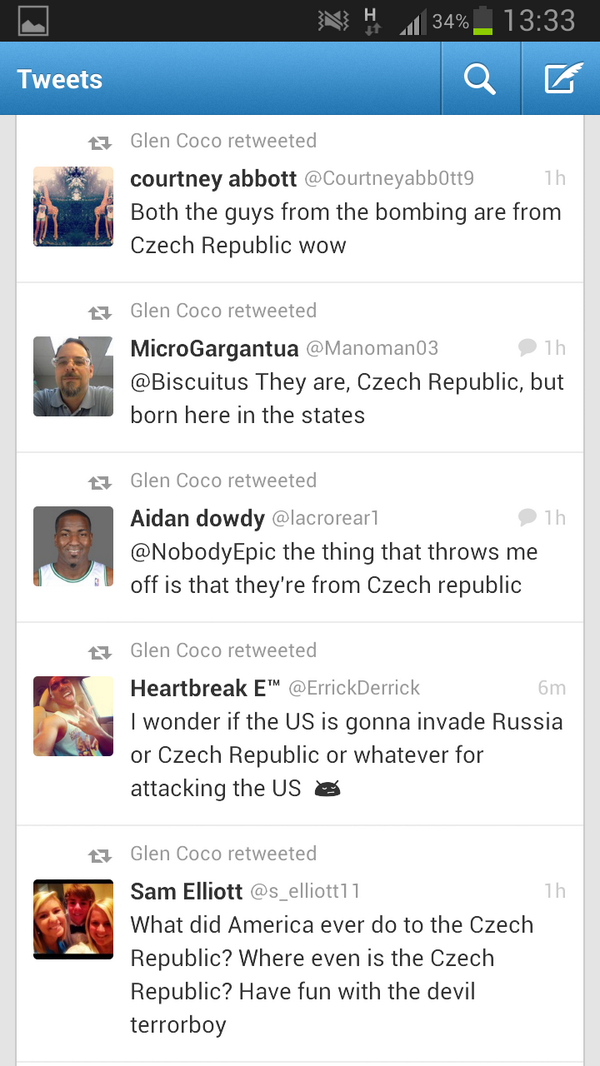
The hunt for the Boston Marathon terrorists turned out to be faster, more efficient, and more dramatic than I expected. One of the results of the developments is that most Americans want my country to be bombed. ;-)


The Huffington Post offers some helpful graphics to help Twitter to remind itself that Czechia isn't Chechnya. Even the Czech ambassador to the U.S. had to publish a special press release LOL. Also, see this huge collection of tweeting Americans who confused the places, via Jason Brown.

What I find characteristic is the symbiosis of this breathtaking yet proverbial ignorance of geography with the political correctness. All foreign nations are apparently equally good and equally important and it's OK to mix them up in this way. Well, let me tell you something.

Chechnya, the original homeland of the terrorists (well, they're administratively from the adjacent Republic of Dagestan but they're still ethnic Chechen), is a tiny region in the Caucasus with 1.2 million inhabitants who are mostly savages with almost no economic activity. The Czech Republic is a somewhat important cultural nation in the middle of Europe, 1,500 miles away from Chechnya, while Chechnya is just a pain in the neck of Russia.


Chechnya is the most important borderline region that is trying to pump Islam into Russia; Czechia is the most atheist country in the world. The last difference is where the wind really blows from; the Boston Marathon attack was just another terrorist act by Islamic fundamentalists – although ones with an ethnic background that is somewhat unusual in the U.S. After all, they used a cooking explosive right from the Al-Qaeda textbooks.


However, this ethnic background is not unusual for terrorist attacks in Russia at all. (They shouldn't really be called "darker faces" because they're typical Caucasians and "Caucasian" has become a word for the prototype of the white race.) Recall e.g. the 2002 Moscow theater hostage crisis. In the West, some events of this sort are sometimes spun as examples of an evil large nation of Russia that suppresses the freedom warriors such as those in Chechnya.

In reality, these folks are terrorists of the very same kind as those mostly Arab ones that are more familiar in the U.S. But it's a common feature of the double-faced postmodern media to evaluate almost the same event in two diametrically opposite ways – depending on who is the victim.


One of the two attackers, Tamerlan Tsarnaev (the guy who was killed: his brother Dzhokar is in custody now), has favorited five YouTube videos; via the Foreign Policy Blog. Most of them are Russian-language videos and their main goal is to worship Allah or, in one case, to attack the Chechen leaders who co-operate with Moscow. The first video admires Allah because He is a chameleon. The last, English-speaking video is about Allah and as far as I understand, it is a relatively peaceful one. But I can't resist to point out that it is just so stupid. The people who are impressed by this low-brow religious babbling must be extreme morons – (almost) whole nations of morons. Some of them turn out to be killers but this may be just an accidental consequence of their being extreme morons.

I am disturbed by the fact that most of the U.S. media are trying to suppress the debate about the basic identity of the terrorists. It's another example of political correctness run amok, it's what allows so many ordinary Americans to conclude that the terrorists were Czech, and it's extremely dangerous because many extra bad things may happen to you if you don't know your enemies. It seems to me that even when the Americans learn about their Chechen-Czech mistakes, they won't feel guilty because they will think that Czechs shouldn't be insulted if they're compared to the Chechens. Well, the only reason why we're not insulted is that we know very well that most Americans are ignoramuses who don't have a clue about the world behind the U.S. borders (not to mention the Solar System) so we treat them in the same ways as puppies who violate some rules of grammar while barking.


A map of the official countries in the region. Chechnya is a de facto country around Groznyy ["Horrifying, horrible" in Russian] in the map.

Fox News is a positive exception here because the station tries to discuss whether they are Chechen separatists or Islamic terrorists – and concludes it's the latter. I am not 100% certain whether the conclusion is right but I am almost 100% certain that the right description is one of the two descriptions in the Fox News' title.

For those Americans who don't get their data from Fox News, most of these things will remain taboo. So the perpetrators will remain some random people from a nation starting with Č – whether you spell it as Ch or Cz is already beyond their resolution – and the motive and thinking behind the acts will remain an almost complete mystery.

I can't believe it. This result depends on the media's deliberate obfuscation and censorship of the basic facts in the name of (pro-Islam, in this case) political correctness; it also depends on the lack of readers' desire to know the truth. It seems to me that most people who follow these stories don't even dare to ask "Why" i.e. "Why they did it".

An article by Earl Ofari Hutchinson provides us with an insight into the censors' minds: hunt terrorists, not witchhunt Muslims. Nice except that the goal here is to obfuscate that it's probably the Islamic terrorism that Boston has faced.

I am also amazed by articles such as this one in Long Island News. The Russian community in Brooklyn is so surprised that their "compatriots" have done such a thing. The basic message seems to be that Russia is responsible for everything that the Chechens do. In reality, it's just like if you force Americans to apologize for what their compatriots who are Afghani did: Afghanistan has a similar "protectorate" status relatively to the U.S. as Chechnya has relatively to Russia. Would you agree that in the Afghan-American case, it would be crazy?

I am convinced that a vast majority of Russians don't consider to be the very same nation with the Chechens. To say the least, the Russians don't speak the Chechen language – which is an extremely different, archaic language of the Caucasus.

This sort of ignorance about geography is bound to become even worse in the future if the political correctness and the taboos imposed by it continue. In effect, the media and other "official pundits" (which arguably include the schools) are teaching the people not to be interested in the basics of cultures, religions, nation-specific values, and pretty much all differences between various groups of people because they're already building a "unified people". People who don't discuss whether the terrorists were Muslims are apparently labeled "nice" even though a more accurate description would be "uneducated and brainwashed imbeciles".


Dzhokhar Tsarnaev's skin is as white as you can get. He is a Caucasian and the "Caucasian" nations are the defining ones for the white race. Still, you may perhaps see something Eastern in his handsome face and being white doesn't protect one from behaving as a savage. In certain nations, this behavior is far more frequent than in others.
Read More
Posted in freedom vs PC, Middle East, murders, politics, religion | No comments

Friday, March 8, 2013

Science cannot answer moral questions II

Posted on 8:51 AM by Unknown
I wrote about the same topic three years ago and probably at many other places, too. However, Sean Carroll revived the topic again,
Science, Morality, Possible Worlds, Scientism, and Ways of Knowing
and because I still agree with him, let me review and add some relevant arguments.


Carroll says that scientifically meaningful propositions are questions about the past, the present, the future, or the eternal laws that
  • might in principle be both false and true
  • admit a method, at least in principle, to evaluate their truth values.
He mentions three examples. Oxygen is distributed throughout the body by circulating blood. The Universe is expanding. The Sun will run out of the thermonuclear fuel in several (7.5 or so) billion years. They happen to be true.


He also gives you examples of propositions that don't belong to science because one of the disqualifying conditions below holds:
  • they're purely mathematical in character so they require no empirical input at all
  • they're statements about fictional objects such as Hamlet that can't be decided from the only available data, in this case the text of Hamlet (there's no "real Hamlet" offering "additional data")
  • they depend on subjective opinions and preferences
The last group happens to contain not only the people's favorite ice creams but also most moral questions, whether or not someone likes the fact that morality is in the same category with ice creams.

I completely agree with all these propositions. It may be useful to discuss some additional opposition. Many people who tend to say that morality may be derived scientifically are inclined to define morality as something positively correlated with the principle
We should work to maximize the well-being of conscious creatures.
Well, not everyone agrees with this thesis – count me as an agnostic here – but even those who do agree can't transform this assumption into science because pretty much by construction, this thesis (about the rightness of improvements of the well-being) is as vague and subjective as the original one (about morality in general).

How do you quantify the well-being of conscious creatures? The first problem is that even the "conscious creature" isn't really well-defined. This point is ultimately nearly equivalent to the deep moral disagreement of people of different religions or ideologies. I am referring to women's rights, animal rights, savages' rights, infidels' rights, poor people's special rights, homosexual rights, humanrightism in general, and so on. Different ideologies inevitably differ in the weight they attribute to different subjects' right to contribute to the "body of conscious creatures" and in the evaluation of their right to enjoy "well-being in their characteristic way".

Second, even if you knew who is a conscious creature and how important this creature should be in the definition of morality, it's still true that their well-being is not measured in meters, seconds, kilograms, joules, kelvins, electronvolts, candelas, and not even in dollars. Some people may decide that well-being is very close to some of those – the more sensible people could express it in dollars but the really unhinged ones may use an arbitrarily crazy unit, e.g. one negative gigaton of carbon dioxide, to measure the well-being of conscious creatures.

In science, we often lack the "best definition" of a concept – for example, we still feel that there might be some universal equations of string/M-theory – and it's therefore sensible to expect that certain things will become not only scientific but rigorously defined, high-precision concepts in the future.

However, pretty much by its basic character, this is not the case of morality. Imagine that you find some quantity M encoded in the equations of M(orality)-theory in the future and you will claim that it measures morality. It may be given by a pretty formula. I don't know whether it would be a local or global quantity – none of the options makes too much sense – but there will be a nice formula.

The problem is that even with this nice and well-defined formula, one may always legitimately refuse such a measure of morality and choose a completely different one. We may consider M as the measure of morality to be misguided for particular reasons. We may even consider the very idea of converting morality into a mathematical expression to be deeply immoral. At most, M would be another competitor of the Bible and Quran and Marx's books.

We may look what's wrong with various attempts to quantify the well-being. For example, Hugo Chavez died and some people – including some politicians who are supposed to represent the people of Europe but they behave shamefully instead – have argued that Chavez has been a great politician who has improved the well-being of the people of Venezuela. Now, I must say: give me a break with this communist garbage!

Venezuela has lots of fossil fuels and a great potential but what we see is an oppressed country with B-class ratings, unexplainable debt that is already at 50% of the GDP. They're 177th in the "easy of doing business rank" which is next to catastrophic. Lots of people remain unemployed, lots of people are below the poverty line. Relatively to other excessively oil-rich nations, Venezuela's GDP per capita is low.


The White Town's 1997 song, Your Woman [I could never be your woman], has made it to Lumo's all-time 100 hits. Because it's a song by a straight girl in love with a lying, two-timing, fake-ass Marxist who has manipulated her, I dedicate it to Hugo Chavez – the girl is a metaphor for the Venezuelan nation – and wish him a smooth and uninterrupted trip to Hell in whose existence I temporarily believe just for this special occasion.

Chavez's posthumous children may refer to some special indices created by the United Nations. That's great but these indices are artificial pieces of propaganda composed by Marxists and by the terrorist friends of Chavez, Ahmadinejad, and their Western politically correct apologists – all these bastards de facto "own" the United Nations. There's nothing credible about those things. They're deeply immoral.

Many of these indices – attempts to quantify the well-being of conscious creatures – incorporate egalitarianism as a positive condition. The smaller the wealth inequality is, the better, these commies want to argue. Give me a break with this junk. There is nothing nice or ethical about egalitarianism and there is nothing wrong about wealth inequality. Wealth inequality – the concentration of capital – has been both an inevitable and by definition fair and just consequence of people's varying contributions to others (plus some fluctuations that are explained by less noble causes but there's no reason for the total inequality to equal zero); as well as a necessary precondition for the progress of the human society.

People who back egalitarianism are downgrading the humans into cattle of a sort, cattle that is measured either in kilograms or pieces. Mass brainwashing and indoctrination of the citizenry becomes pretty much another "must" for everyone who wants to create an egalitarian society. When people are treated in this way, they obviously become less conscious, less thinking. People actively supporting egalitarianism are inhuman hyenas who should be tried for crimes against humanity and perhaps executed if the well-being of the conscious creatures is our goal. Now, I can't give you a scientific proof – neither a rigorous mathematical proof nor a rock-solid piece of scientific evidence – that the previous sentence is true. What I say is still true although it's true in a different sense than scientific propositions.

Some people who suggest that moral questions may be settled by science are usually narrow-minded folks who agree with a couple of their friends – or a mass movement of a sort – and because these friends or movements also tend to pay a lip service to science, they identify science with the morality. But even if their support for science went beyond the lip service, it would still be incorrect to identify science and a particular kind of morality just because both are supported by the same group(s) of people!

At the end, it seems to me that the people promoting a "scientifically established morality for everyone" haven't even tried to think about the immense diversity of viewpoints, values, and priorities that make the moral opinions of the mankind across the space and time so non-uniform. Let me give you an example.

Last night, our Pilsner soccer team, Victoria, was beaten 1-to-0 by the visiting Fenerbahce Instanbul, a very rich team supported by 1/3 of the Turks worldwide. It was a sort of surprise for our celebrated team but the Turks were playing better than us – and therefore much better (and in a more organized way) than teams such as Napoli. But that's not what I want to talk about. ;-) Twenty minutes ago, I bought and ate a kebab box in my favorite nearby kebab shop. They raised the prices today, bastards! But the prices are also not the topic here.

What I want to say is that these Muslim nations are slaughtering animals in the halal way – it's their version of the Jewish kosher way. They find blood to be unacceptable in food and the execution of the animals corresponds to these principles. The Egyptian guy has warned me about that many times. I checked – and yes, the halal slaughtering involves cutting the animal near the throat and discharging pretty much all the blood from the body.

It looks cruel, I want to cry, vomit, or whatever, but I was nearly killed 16 years ago in almost the same way (and it was my birthday) so it's no real science-fiction (some seven stitches or so did the job). Moreover, the European ways to slaughter animals seem terribly cruel to me, too. And at the end, even if you make an animal (or human) sleep so that it doesn't realize that it dies when it does, I still find it horrible. Differently horrible, creepy, but still horrible.

If you believe that some of these methods are particularly moral or immoral, you may feel extremely strongly about it but as long as you stay rational, you must realize that your feelings (and even the "right" suggestive analogies between things) are emotional, formed by your education, background, experience, perhaps genes of your family and nation, and it's completely possible that someone feels differently or very differently. These preferences are like the preferences for the best ice cream. I am surely not saying that all viewpoints are equally good; of course that only mine are any good. I am just saying that the validity of a moral system can't be proved in the same way as statements about hard sciences.

I want to mention one more alternative albeit related definition of immorality to compete with the well-being:
A habit, tradition, behavior, or even opinion that threatens the very fabric of the society is immoral.
Again, one could get many people subscribe to this thesis. It's perhaps more conservative than the morality based on the well-being (the latter smells of a progressive bias – it is not shocking that it was picked by Sean Carroll) but it's not too different. The problem is that the "fabric of the society" is inevitably so much ill-defined that there can't ever be a rigorous "scientific verdict" about morality based on this criterion, either. Moreover, whether or not the society will be undermined by a particular behavior is not only "unpredictable deterministically" but it is really unknown in advance. Even if the "fabric of the society" and its preservation were rigorously defined, which is too much to ask in the real world, we could at most calculate the probability that this fabric will be destroyed because of a particular behavior.

This probability would be a number between 0 and 1. Which threshold would be tolerable? There's clearly no objective, unique, canonical answer. Moreover, the calculated probability depends on many other assumptions.

An example. During the life of Giordano Bruno, many powerful Catholics believed – unfortunately for Bruno – that heliocentrism was undermining the very fabric of the society. If people started to believe heliocentrism, something terrible would happen. What would the Armageddon be? Perhaps, the inertia from the floating Earth would throw us to outer space. Well, that's not really possible because the Sun's gravitational force acts equally on the Earth and the objects on it which is why the centrifugal and centripetal (gravitational from the Sun) forces pretty much cancel, up to tides, but yes, the understandable misunderstanding of this point (those people lived before Isaac Newton and his laws) was a reason why many people couldn't internalize the physics of heliocentrism.

But of course, the actual worries were different. It was believed (although some people had to promote this belief first: this anti-heliocentric hysteria wasn't dominant during Copernicus' life) that the Bible stated that the Earth had to be the center of everything and it was a key proposition. So any violation of this wisdom would undermine God, the body of His or Her believers, and their faith. They would quickly begin to sleep with their siblings, eat each other, Mr or Mrs God could get pis*ed off very quickly and very severely, and roughly speaking, the mankind would go extinct very rapidly.

This was the ideology behind the belief that heliocentrism was immoral and Giordano Bruno had to be burned at stake. Well, this worry hasn't materialized. The mankind no longer believes geocentrism much. Even the Catholic Church has largely abandoned it. But the mankind still exists. Even the Catholic Church is still around. It still has a Pope – well, not right now, but maybe it will have one next week.

So some belief about the "collapse of the human society" because of something turned out to be immaterial. There are lots of wrong beliefs – wrong because not sufficiently scientifically backed – underlying many or all ideologies that claim to determine what is moral and what is immoral. This is the easy part of the problem. I think that everyone understands that the worries turned out to be misplaced which means that this particular reason to promote execution of Giordano Bruno for heresy was bogus. The society and even the Church may work independently of beliefs in geocentrism or heliocentrism.

But I also want to emphasize a different point, one that is easily overlooked with the hindsight. And the point is that the moral arguments of the Catholic prosecutors had a logic and they could be right. The coupling between the fate of geocentrism and the fate of the mostly cultural Western society was weak but it was nonzero. The probability that the loss of the Church's authority would turn the Western nations into hordes of savages was arguably nonzero. More importantly, there are other situations in which the coupling is perhaps stronger and similar worries turn out to be justified.

In some cases, the society adjusts to some "potentially crippling" changes. In other cases, the changes may be so crippling and unadjustable that the society gets crippled, indeed. When the society gets adjusted, it's a slightly different society – we could say it is a mutated society – afterwords. For such a mutated society, someone who claims to quantify or "scientize" morality has to adjust all the rules, too. This quickly becomes an unsolvable problem where everything is coupled to nearly everything, all the coupling constants are unknown, their effects' morality is undefined, and it's just a mess.

One method to appreciate how unscientific all propositions about morality are is to try to apply your moral rules to some very distant societies – ideally societies that are separated by thousands of years (or more) from ours. If you're the best morality expert in the world of 2013, how will you teach the Neanderthals to be ethical? What about the future people who live in the Idiocracy of the 26th century? Clearly, the folks in both distant worlds live completely different lives and have different interests, concerns, and priorities. Even the notion of murder may get a totally different flavor due to different needs, different technologies to kill, and so on.

Your moral rules will largely mean nothing to them. Even if you strongly believe in your moral rules, you shouldn't overlook that they're provincial rules that are largely inapplicable to general enough situations – situations in which the people are too far spatially, temporally, or culturally. And that's an attribute of something that is decidedly unscientific because the scientific laws should be pretty much constant in time. Otherwise they're not really laws. The laws of moralities are inevitably descriptions of a subset of people's subjective opinions that are relevant and believed to be valid in a limited region of spacetime and the society and that may only be demonstrated to be "clearly better" than competing systems of morality if the two systems sort of fairly compete and show where their beliefs go.

However, even if you could make the competition fair, you will still have trouble with this criterion because a society may thrive due to good luck or some (genetic and other) prerequisites that are independent of the moral system so no victorious outcome is a clear proof of moral propositions, either. Moreover, you cannot step into the same river twice. Important enough "moral experiments" are unrepeatable (because the society or at least its knowledge is changing) and fail to obey the scientific requirements of reproducibility.

So I surely think that science will never become adequate to settle moral questions in practice – except for totalitarian societies where all the people are forced to believe certain things and nothing else – but I also think that moral questions are outside science even in principle.
Read More
Posted in philosophy of science, religion, science and society | No comments

Wednesday, February 13, 2013

Klaus on abdication of Benedict XVI

Posted on 3:59 AM by Unknown


I was sorry to learn about the reports that Benedict XVI resigned. Whatever the reasons behind the Pope's surprising decision were, the decision makes me sad.


For 8 years, Benedict XVI has been not only the leader of the Catholic Church but also a globally prominent statesman. In the wake of our meetings – both his visits to the Czech Republic, as well as those in the Vatican – but also from his numerous public appearances, speeches, and texts, I could perceive the proximity of our attitudes. He belonged among the rare personalities of the contemporary world who don't ride the cheap wave of the omnipresent progressivism. He was aware of the dangers that follow from the loss of the traditional values, the threats posed by the decaying institution of a family and a nation state as well as from the precipitous European integration project. He was able to make these concerns of his visible. That is why he was frequently attacked by the media – something I could understand well, too.


The lightning was genuine.

Despite his relatively short pontificate, the Holy Father Benedict XVI has left a visible trace in the world. I view his resignation as a symbolic part of the symptoms of the end of an epoch in which the voices warning about the direction that the contemporary world has taken could still be loudly heard. This is also how I understand the unsuccessfully masked joy of those who accepted his unexpected gesture with hypocritical acclamation. Those who are losing an important political and intellectual ally have no reason to rejoice. Pope Benedict XVI surely deserves thanks for his brave yet unfinished struggle.

Václav Klaus, February 12th, 2013, original in Czech
Read More
Posted in Czechoslovakia, Europe, freedom vs PC, politics, religion | No comments

Monday, February 11, 2013

A proof of Intelligent Design?

Posted on 8:13 AM by Unknown
I hope that the title isn't too provocative. ;-)

Bill Z. has brought my attention to a December 2012 nuclear physics paper that was updated 3 days ago,
The fate of carbon-based life as a function of the light quark mass
They (Evgeny Epelbaum, Hermann Krebs, Timo A. Lähde, Dean Lee, Ulf-G. Meißner) try to determine the precision with which God or non-God had to fine-tune the average light quark mass – a parameter defined as \((m_{\rm up}+m_{\rm down})/2\) – in order to guarantee that there would be enough carbon, oxygen, and other elements that are crucial for the type of life that is recommended by 4 of 5 dentists.

The detailed calculations are concerned with the Hoyle state. What is it and what did the authors of the new paper conclude?


In 1954, Fred Hoyle noticed that we were lucky about a seemingly technical coincidence in nuclear physics that was apparently needed for us to exist. Note that in the baryonic (proton- and neutron-based i.e. visible) matter in the Universe around us, hydrogen and helium are the dominant elements.

It's no coincidence. It was mostly hydrogen (\(Z=1\)) and helium (\(Z=2\)) – and just some lithium (\(Z=3\)), aside from negligible trace amounts of heavier elements (\(Z\geq 4\)), that was directly produced during the Big Bang nucleosynthesis in the first three minutes after the Big Bang. One may reconstruct the temperature in the Universe during these early formative stages of our Cosmos and calculate, using the statistical methods, the ratios of the concentrations of these three light elements. The results seem to match the observations of hydrogen, helium, lithium rather impressively – and this agreement is one of the important pieces of evidence supporting the Big Bang paradigm.

Looking from a practical perspective, are the three lightest elements enough to get everything we need to be happy? Well, lithium may be helpful for some laptop and cell phone batteries and helium is useful at most for funny tricks to change your voice into the voice of the Smurfs (fine, it's also great as the gas in balloons, either for kids or adults, and as the coolant in NMR and the LHC). We could also describe helium as the main waste product of the thermonuclear reactions in the Sun and other stars if it weren't too disrespectful.

Hydrogen is useful for a huge fraction of compounds we need and love. But where is the rest? It's obvious that the three elements aren't enough to build life and the civilization as we know it. In particular, two other major heavier elements behind the miraculous project of life – carbon and oxygen – seem to be absent. Yes, these are the same two elements found in the gas that they call a pollution but we call it life.

Aside from hydrogen, carbon, and oxygen, the three major elements, nitrogen, phosphorus, and sulfur are three more elements that are paramount for life we know. Other elements such as silicon or calcium or fluorine (because I mentioned the dentists) may be helpful to shape our bodies at various moments and/or to create various intelligent gadgets but they're no longer a universal "must". Where do all these elements come from?


The heavier elements are abundantly enough produced by helium burning in stars that have gone red giants. Our carbon, oxygen, and other elements arose from the production in these red giant stars that once existed but they are no more. In 7.5 billion years or so, our beloved Sun will become a red giant, too. It will devour the Earth and other planets – that's the less dramatic part of the story – but it will also produce completely new carbon, oxygen, and other elements that may be incorporated into the bodies of a future extraterrestrial civilization.

Fine. How do the red giants produce carbon (\(Z=6\))?

Note that six is a multiple of two: we call these numbers "even". So it has the right number of protons to arise from several, namely three, nuclei of helium which seem abundant. Moreover, the ordinary carbon nuclei we need have 6 protons and 6 neutrons, the same number, so it seems appropriate to combine three helium-4 nuclei to create carbon-12:\[

\Large {}^4_2{\rm He} + {}^4_2{\rm He} + {}^4_2{\rm He} \rightarrow {}^{12}_6{\rm C}

\] It's somewhat unlikely for three helium-4 nuclei – which I will call the alpha-particles just like everyone else – to hit each other and produce the carbon nucleus directly. So the reaction actually proceeds in two steps, with an unstable level of beryllium-8 or \({}^8_4{\rm Be}\) in between. This beryllium-8 nucleus combines with another alpha-particle to get the desired carbon but this second step has too low a rate.

We wouldn't get enough carbon in this way (if it were just a generic fusion of these nuclei) and it's actually known that something special is going on. There is a resonance, a \(0^+\) state of carbon-12 known as the Hoyle state. Fred Hoyle actually predicted – using the apparent abundance of carbon as the only input – that it should be somewhere over there and indeed, the prediction was soon experimentally confirmed.

There exists a state of carbon-12 whose mass/energy is equal to the mass/energy of three free alpha-particles plus \(\varepsilon=397.47(18)\keV\); we say that the state is \(\varepsilon\) above the three-alpha threshold (a threshold, in general, is the minimum mass/energy of an unstable/composite object that allows the corresponding state to decay to particular products without violating the energy conservation law).

In the relevant region of the parameter space, the reaction rate for the carbon-12 production – via the Hoyle resonance – may be approximated by \[

r_{3\alpha} = \Gamma_\gamma (N_\alpha/k_B T)^3 \exp(-\varepsilon/k_B T).

\] You see that up to an overall normalization constant, this is equal to the third power of the number (density) of alpha-particles per unit volume (because three of them have to meet) and a Boltzmannian factor that exponentially decreases with energy. This \(\varepsilon\) shouldn't be too high because the exponential suppression could be severe. It shouldn't be too small, either, for other reasons. In the past, it was argued that a 15% deviation of \(\varepsilon\) from the known value could still allow enough carbon etc. for life.

Now, what have they found about the dependence of this accident on the light quark mass?

They use a novel numerical method, nuclear lattice simulations, to calculate the dependence. It's something like lattice QCD except that it seems to work with some composite pion fields and the low-energy emergent nuclear physics mess instead of the fundamental QCD fields. The light quark mass is translated to the mass of the pion \(M_\pi\) and they discuss the dependence of the energies of several energy levels on either the light quark mass or the pion mass which is almost the same dependence.

I don't want to bore you with all the details – you may read the original paper, it's just 4 pages long. Instead, let me repost a graph summarizing some partial results of their analysis:


On the \(x\)-axis, they depicted the relative change of the binding energy of the alpha-particle; on the \(y\)-axis, you see the corresponding (much larger) relative change of the three energies related to the helium-4, beryllium-8, and carbon-18 nuclei, namely of\[

\eq{
\Delta E_h &= E_{12}^* - E_8 - E_4\\
\Delta E_b &= E_8 - 2E_4\\
\varepsilon &= E_{12}^* - 3E_4 = \Delta E_h + \Delta E_b
}

\] Because of the final relationship for \(\varepsilon\), it's not surprising that the yellow curve is in between the other two. But what may be surprising is that these two curves – and therefore all three curves – have pretty much the same slope. What does it mean? It means that the several fine-tunings are actually not independent from each other.

You could think that for the nuclear factory to work and produce the elements, you may need several miracles – several anthropic conditions, in this case three – and therefore God has to be even greater than the size He would adopt if there were just one miracle. God's omnipotence seems like the third power of a generic god's power (or three times? It depends whether His omnipotence is quantified on the log scale).

However, the new paper shows that this ain't the case. The three coincidences aren't independent from each other. Pretty much because of mathematical identities, they're more or less equivalent to one coincidence only. If one identity for the nuclear level energies holds, the other two will probably hold as well, with a highly acceptable accuracy. It means that one miracle is enough and life is much more likely than what you would expect if you thought that the three conditions are independent of each other.

Now, you could claim that we still need meta-God to explain the mathematical "metamiracle" that the three conditions are actually almost equivalent to each other. If you did so, you would cover these questions by lots of exciting religious fog. But the matter of fact is that they can actually explain this "metamiracle" – at least in a preliminary way – in terms of completely non-mysterious, irreligious arguments, too. The same slopes kind of follow from the alpha-cluster structure of beryllium-8 and carbon-12 nuclei. I won't present this derivation in its full glory but the alpha-particle-based compositeness of the two nuclei sort of rationally explains why the two slopes are almost the same.

Even though several levels and energy differences are involved, the authors de facto show that there is only one "miracle" we need for a sufficient production of the heavier elements behind life. Moreover, the tolerated error for \(\alpha_{\rm elmg}\) as well as \(m_q\) could be around 2 percent or so: the fine-tuning isn't extreme.

Although this very topic may make you "wish" that there is some evidence for the Intelligent Design and/or a stunningly convincing role for the anthropic principle, and the very fact that a paper about this metaphysical and mysterious question was written could manipulate you into a more spiritual thinking, I would say that the actual results of their analysis imply exactly the opposite conclusion. Different "miracles" aren't really independent from each other and they're not "terribly unlikely miracles", anyway. Good luck at the 1-in-50 level seems to be enough for the amount of carbon to be just fine. At most, you may need two such 1-in-50 fine-tunings – one for the fine-structure constant and one for the light quark mass – except that I think that only some combination of them will have a high enough impact on the essential processes needed for the elements of life to arise.

Now, you could still argue that 1-in-50 is a low chance. The probability \(p=0.02\) or so is pretty small, some of you could say, and this strengthens some arguments in favor of God, Intelligent Design, the anthropic principle, or something along these lines. Well, perhaps. I don't think it's a right way to think about this coincidence. Why?

First, \(p=0.02\) is equivalent to a "bump just a little bit larger than a 2-sigma bump". To make extraordinary claims about God or the anthropic principle – and one really doesn't know which of these (or other metaphysical) explanations "follows" from the "miracle" – and justify them by not-so-extraordinary evidence such as 2-sigma bumps seems to betray the lack of evidence. Extraordinary claims require extraordinary evidence and this ain't one.

Second, this not-so-extreme probability \(p=0.02\) is the \(p\)-value before the look-elsewhere effect of a particular type is included. What I want to say is that we're computing the probability that a particular system of nuclear furnaces will be able to produce a particular type of life (determined by its elements etc.). However, there could very well be other types of life – perhaps \({\mathcal O}(50)\) types of life – that may arise in the same parameter space which means that the probability that at least one of these types of life will be allowed for a "random" choice of the values of parameters may approach 100 percent.

These observations of coincidences that are needed for life are intriguing but we shouldn't get carried away for two basic reasons. First, as argued above, the probabilities that we get a tolerable value of the parameters (values compatible with life) aren't extremely tiny and we should treat these "modestly suggestive" low probability just like any other 2-sigma bumps in physics. They're not enough to settle a question, they're not enough for a paradigm shift.

Second, it's pretty much guaranteed that if we calculate the odds that some "conditions constraining parameters that makes the theory friendly to life as we know it" are obeyed, it's unsurprising that the answer will probably be Yes because our type of life does exist, after all. The proposition that "conditions apparently needed for this life to arise with a significant probability were satisfied" is pretty much tautologicaly true. These conditions simply aren't independent of some empirical known facts. We're just measuring the answer to the question "Does life exist?" using a different, perhaps more contrived, procedure. But the fact that many such questions have "Yes" answers isn't a miracle; it's pretty much tautologically guaranteed because these questions were cherry-picked by their equivalence to the existence of life (or some of the aspects of this existence).

If the probabilities arising in similar anthropic coincidences were much tinier, i.e. much more extreme than 2-sigma bumps, I could be impressed. The tiny cosmological constant could be an indication of this sort. However, we may only argue that the "probability that the cosmological constant is below \(10^{-120}m_{\rm Planck}^4\) is of order \(10^{-120}\)" if we adopt a uniform probability distribution for cosmological constants in the interval comparable to \((0,m_{\rm Planck}^4)\).

While some plausible models that make the uniform distribution look natural exist, they're not "inevitably true" and it's still easy to imagine that this uniform probability distribution is a completely naive, wrong expectation. If we replace it by another one – one that follows from a slightly sophisticated mechanism and one that gives tiny values of the cosmological constant with far higher probabilities – the "unavoidably impressive" miracle goes away once again. If you wanted to convince me that there is a miracle that harbors strong evidence in favor of the anthropic reasoning or God or anything like that, you would have to show me a coincidence that has a tiny probability according to the right calculation of probabilities (a calculation which takes all mathematically guaranteed correlations such as those above into account) and a nicely justifiable probability distribution for the parameters.

If you used a quasi-uniform one, you would have to convince me that it's reasonable to expect that the distribution is quasi-uniform for that situation. It would have to be so reasonable – almost inevitable – that, in fact, I would find your anthropic principle or God more likely as an explanation than the mundane possibility that there simply exists a better argument or "better theory" telling you that a non-uniform distribution is actually a much more sensible (and likely) one. Or a better theory that simply allows you to calculate the observed value. How strong evidence is needed to prefer God over the "better theory" depends on subjective prior probabilities but be sure that 2-sigma or even 3-sigma bumps are way too small for people like me to pick God or His best pal, the anthropic anti-God, instead of a "better, so far unknown, theory".

If you can't show me such a thing, I would keep on insisting that there doesn't exist any tangible evidence to believe the anthropic/religious paradigm and because these things aren't mathematically elegant or explaining any true pre-existing mysteries in physics, they don't really deserve to become a part of physics, at least at this moment.
Read More
Posted in astronomy, landscape, religion, string vacua and phenomenology, stringy quantum gravity | No comments
Older Posts Home
View mobile version
Subscribe to: Posts (Atom)

Popular Posts

  • Likely: latest Atlantic hurricane-free date at least since 1941
    Originally posted on September 4th. Now, 5 days later, it seems that no currently active systems will grow to a hurricane so the records wi...
  • Amazon: 3D printers below $1,200
    When Howard Wolowitz bought a 3D printer to print figures of himself, Rajesh Koothrappali, Bernadette Rostenkowski-Wolowitz, and other heroe...
  • New iPhone likely to have a fingerprint scanner
    One year ago, Apple bought AuthenTec , a Prague-based security company ( 7 Husinecká Street ), for $356 million. One may now check the Czech...
  • A universal derivation of Bekenstein-Hawking entropy from topology change, ER-EPR
    I have been intrigued by topology change in quantum gravity, especially its Euclidean version, for 15 years or so. Since the beginning, I li...
  • Valtr Komárek: 1930-2013
    U.S.: As predicted and discussed on TRF exactly 3 months ago , Ernest Moniz became the new U.S. secretary of energy. Valtr Komárek died to...
  • Spanish train crash: quantifying the acceleration
    A tragically motivated homework problem in mechanics Chances are that you have already seen the dramatic video of the Wednesday Santiago de ...
  • An apologia for ideas from Hawking's BH bet concession
    In Summer 2004, Stephen Hawking conceded his and Kip Thorne's bet against John Preskill: Preskill was the only one among the three who s...
  • Confusions about the relationships of special relativity and general relativity
    Sabine Hossenfelder wrote about the confusions surrounding the relationship of Einstein's 1905 special theory of relativity and Einstei...
  • Anthony Watts' television channel
    Al Gore has a new TV competitor Last year, Al Gore's Climate Parody Day spent millions of dollars and attracted a few thousand viewers ...
  • A slower speed of light: MIT relativistic action game
    In the past, this blog focused on relativistic optical effects and visualizations of Einstein's theory: special relativity (download Re...

Categories

  • alternative physics (7)
  • astronomy (49)
  • biology (19)
  • cars (2)
  • climate (93)
  • colloquium (1)
  • computers (18)
  • Czechoslovakia (57)
  • Denmark (1)
  • education (7)
  • Europe (33)
  • everyday life (16)
  • experiments (83)
  • France (5)
  • freedom vs PC (11)
  • fusion (3)
  • games (2)
  • geology (5)
  • guest (6)
  • heliophysics (2)
  • IQ (1)
  • Kyoto (5)
  • landscape (9)
  • LHC (40)
  • markets (40)
  • mathematics (37)
  • Middle East (12)
  • missile (9)
  • murders (4)
  • music (3)
  • philosophy of science (73)
  • politics (98)
  • religion (10)
  • Russia (5)
  • science and society (217)
  • sports (5)
  • string vacua and phenomenology (114)
  • stringy quantum gravity (90)
  • TBBT (5)
  • textbooks (2)
  • TV (8)
  • video (22)
  • weather records (30)

Blog Archive

  • ▼  2013 (341)
    • ▼  September (14)
      • Likely: latest Atlantic hurricane-free date at lea...
      • Democrats of Europe, wake up!
      • Confusions about the relationships of special rela...
      • Yo-yo banned in Syria
      • Snowden: Internet encryption useless against eyes ...
      • A universal derivation of Bekenstein-Hawking entro...
      • Nathaniel Craig's State of the SUSY Union address
      • Did soot melt glaciers in the 19th century?
      • 16 out of half a billion: elite Calabi-Yau manifol...
      • Lev Pontryagin: 105th anniversary
      • The 50 to 1 project
      • Ukrainian ex-porn star wins legal residence in Cze...
      • An apologia for ideas from Hawking's BH bet conces...
      • Feminists demand gender quotas for bodies buried i...
    • ►  August (42)
    • ►  July (36)
    • ►  June (39)
    • ►  May (38)
    • ►  April (41)
    • ►  March (44)
    • ►  February (41)
    • ►  January (46)
  • ►  2012 (159)
    • ►  December (37)
    • ►  November (50)
    • ►  October (53)
    • ►  September (19)
Powered by Blogger.

About Me

Unknown
View my complete profile