TheReference

  • Subscribe to our RSS feed.
  • Twitter
  • StumbleUpon
  • Reddit
  • Facebook
  • Digg
Showing posts with label missile. Show all posts

Tuesday, August 27, 2013

Getting ready for a war against Syria

Posted on 7:47 AM by Unknown
...robust Czechoslovak weapons unlikely to resist for too long...

The civil war in Syria sucks, like most civil wars. The rebels aren't saints (and Russia accused them of using sarin gas a month ago) but it's the Syrian government that may be expected to behave more responsibly. Given the strong indications that chemical weapons have been used, it's not surprising that the U.S. forces and allies are thinking about an attack that may begin as early as on Thursday.


Photo from syrianhistory.com

Such a reaction of the West is understandable but needless to say, the West may be playing with fire. And with Czechoslovak weapons, too.


An attack against the regime of Assad Jr is likely to be actively led by the U.S., somewhat emotionally supported by France, the next most hawkish Western nation, perhaps by the U.K., and more passively approved by pretty much every Western country (our new president Zeman, an outspoken critic of the Muslim world, immediately reported he wants to send troops to the Golan Heights i.e. to Israel's border region near Syria, in order to secure the superpower status of the Czech Republic and to speed up the incorporation of Assyria into Naphtali's Realm). In contrast with the peace rallies before the second war in Iraq, a decade ago, the peace activists don't seem too excited about protests because a war is raging in Syria, anyway.


The middle tenor, Erdogano (it's the guy who actually sings for everyone), won't support his two tenor comrades on the sides this time. Well, the left chap has been replaced by Rouhani. Music: Funiculi Funicula [CZ] (which surprisingly means "Funicular cable car in Naples is going up, funicular cable car in Naples is going down" – English is less efficient than Neapolitan [and Italian]).

Russia and China oppose the attack but these countries are hopefully not terribly involved in the situation because things could get really messy at the global level. (Saudis are offering oil incentives to Russia if it abandons Syria.) Meanwhile, most countries in the region, including Turkey, Israel, and Saudi Arabia are likely to happily support the attack on Syria (Israel needs to pretend lots of reticence that is probably fake). Libya is slightly against the attack but it won't actively defend Syria.

The most important regional supporter of Assad is obviously Iran and every responsible planner must be ready for the option that the expected American war on Syria will quickly grow into a war against Iran.


This is a Czech blog so I can't resist to semi-proudly ;-) mention a specific dirty role that my homeland – well, mainly its historical predecessor – would be playing in the war.

It just happens that no one else than Syria under Hafez al-Assad (the current leader's dad who was at the top between 1963 and 2000) was Czechoslovakia's most important non-European business partner during much of the 1970s and 1980s. Assad was a clear left-winger of his own sort and Czechoslovakia was his nation's favorite exporter.

The 1975 picture at the top shows the last communist Czechoslovak president, Gustáv Husák (left), teaching al-Assad how to blow the traditional Bohemian glass, at least a simplified version of it. Al-Assad must have been a good student. He also visited Prague in 1985. The reverse visit by Husák to Damascus occurred in 1979.


You may ask what was the most important category of industrial products that Czechoslovakia was sending to Syria. Well, yes, you shouldn't be surprised. Czechoslovakia has always been a great power in weaponry – and yes, my hometown used to play a very important role in that sector as well, but especially 100 years ago – and the answer is therefore weapons. To mention particular products, Syria has bought numerous T-55 tanks (shown on the picture above, during the martial law in Poland; also produced in USSR and Poland) and Aero L-29 Dolphin/Maya jet training aircraft (below; purely Czechoslovak).


At some moment, the Syrian debt with respect to Czechoslovakia grew to $0.9 billion which is a lot of money, especially because of the letter "B" at the beginning. All the debt has been repaid a few years ago. That's a good thing for our coffers because Syria could very well become broke this Friday. ;-)

Needless to say, the Czechoslovak-Syrian relationships changed from the friendly blowing jobs shown at the top to hostile interactions when Václav Havel took over after the Velvet Revolution. Al-Assad Sr has been reported to be properly pissed off by many words that Havel sent to the former ally in the Middle East. Well, Al-Assad Sr stopped communicating with my country but in 2001, when his son was already activated, the communication got restored and the new agreement about the repayment of the debt was signed in 2005 (a part of the debt was forgiven, anyway).


Omnipol, an existing Czech company that is selling similar weapons, is clearly doing some business with partners connected to Syria even these days. (And a few years ago, Wikileaks showed that the U.S. was anxious about these Czech exports in 2006, too.)

I don't know whether it's a part of a plan but our products are able to get to Syria indirectly. For example, some RPG-75s, Czechoslovak single-shot anti-tank weapons from the 1970s, were spotted in Syria this spring. The immediate country that exported it there was Croatia but it's still our weapons. A version of RPG-75 for schoolkids ;-) (or at least it says so) is shown on the picture above.

One must realize that they may have billions of current dollars worth of weapons just from Czechoslovakia which was surely not the only source of their weaponry. That's a lot of gadgets that are able to harm U.S. (and, less likely, allies') forces. Don't get me wrong: I do think that it should be straightforward to beat the Syrian regime, at most in weeks.


However, once again, I sincerely hope that the military planners in the U.S. know what to do when Iran responds in a dramatic way and so on. I also sincerely hope that the traders won't react too hysterically (over half a percent down on Dow Jones; the folks are clearly not calm). It's just Syria and if there's going to be mess in that country, it won't be much different from what is already happening over there now while the potential for a rosier future will be substantial.


Song "Syria" by Mr Sámer Issa, a Syrian-Czech singer and a local 2004 "American Idol" bronze medalist.

A war against a coalition of Syria and Iran could be lengthy, dramatic, and energy-consuming. On one hand, this coalition would be stronger than Iraq – and the war in Iraq was a bit nontrivial by itself. On the other hand, some regional allies could fight against Syria and Iran as well which could make it easier for the West. Do we really know that the benefits exceed the costs – on a human, economic, and political level? Isn't it a pity that the price and value of such an intervention and its consequences for the people in Syria, in the Middle East, and in the rest of the world hasn't been really publicly discussed in the West? I think it is. At any rate, if there's gonna be an attack against Syria, I wish the Western forces a lots of good luck in ultimately bringing some humanity to that country. I say "ultimately" because I don't think that wars can ever make societies more human "immediately".


Love in a Baguette by Mr Xindl X and Ms Olga Lounová, a desirable outcome of the war in Syria: a love song in McDonald's. The guy complains that he has to buy things he didn't want and to supersize them, too – just because she has a crush on the clerk. Aside from several related economics theories, the song also argues that the supply determines the demand. Currently there are no McDonald's restaurants in Syria, one of the signs of the inhumanity of the regime. I won't show you the beheadings and similar horrors because this blog has some taste.
Read More
Posted in Czechoslovakia, Middle East, missile, politics | No comments

Saturday, July 27, 2013

Some amazing technological advances

Posted on 11:07 PM by Unknown
I am getting lots of similar news and sometimes I collide with some of them in the media. Sometimes they sound amazing.

First, MIT has developed a perfect mirror – a material that reflects electromagnetic waves without any losses.


Now, Tesla Motors and Colorado's company SpaceX believe that they can build an amazingly fast superhighway of evacuated tubes where you can drive from California to NYC in an hour.


A combination of magnetic levitation, vacuum would allow minivan-sized capsules to travel up to 6,000 kph and the replacement for the EastCoast-WestCoast air ticket would cost just $100.


Slingatron is a mechanical hypervelocity launcher, a railroad to space, by HyperV Technologies Corp. You may contribute your dollars to that project but this particular project – endorsed by Freeman Dyson – seems a bit premature if not amateurish to me.

Tel Aviv is building SkyTran, a futuristic public transportation system where people are transferred much like the packets on the Internet (physical internet).


The military and navy aren't sleeping, either.


DARPA, the U.S. defense research unit, is planning to build Hydra, an undersea drone carrier.


If you want something that can be inserted into your pocket, what about a mobile smartphone DNA analysis?


Well, the Biomeme's device has a docking station performing a polymerase chain reaction. The results may be sent to the cloud in real time and it's not hard to imagine a speedy system that immediately informs one about diseases by seeing their DNA or RNA signatures.

Let's continue with the medical miracles. Many people have transparent brains – because nothing ever gets absorbed into them. But what about a transparent brain that does its job? Stanford folks developed Clarity, a hydrogel process that makes the mice's brain transparent.


Mice are very helpful collaborators the medical researchers. They implanted fake memories into mice.

Geeks may now use Nerdydata.com, a search engine the focuses on the source code. Habitable planets may be out there but they are very far. We can't get there anytime soon.

3D printing will explode next year as some key patents expire. Arcam AB will grow as well, a Swedish metal 3D printing company. 3D Systems buys a metal printer. Now, people will also be able to print in liquid metals. Boeing is switching to PrintRite3D. 3D printing may change supply chains.


Kawasaki's stainless steel robotic arm has seven degrees of freedom.

Some important paperwork was signed 3 days ago for the Hawaii thirty-meter telescope.

Chromecast, Google's little and cheap $35 cork that you USB-insert into your stupid HDMI TV to create a smart one has been sold out.

It will cost you nothing if you want to detonate a nuclear bomb in a city of your choice. Google Earth is everything you need. ;-)

Impressive technological revolutions are occurring around us. They're driven by a tiny portion of the human population – and those behind each of them are often very specialized, anyway. I am afraid that we're entering a world in which the bulk of the mankind doesn't know what's going on around them which is bad not only because knowledge is good but because the people may be cheated in many new ways. Maybe it's not such a bad thing, however.

Via Viktor Kožený, Czech media, U.S. media etc.
Read More
Posted in biology, missile, science and society | No comments

Friday, March 29, 2013

Reunification of Korea

Posted on 1:17 AM by Unknown
Almost exactly 10 years ago, in March 2003, the U.S. invaded Iraq. I had mixed feelings about that decision and I still have mixed feelings. At any rate, Iraq (#2) used to belong to the Axis of Evil, as defined by George W. Bush, along with Iran (#1) and North Korea (#3). Quite certainly, one original member of this axis is no longer a member.

Note that John Bolton has defined the "Beyond the Axis of Evil Group" composed of Cuba, Libya, and Syria. Cuba has softened somewhat and Raul Castro is planning to retire; the Libyan regime has been overthrown so a re-evaluation would be appropriate; and Syria is in the state of a Civil War, we will see what comes out of it. (Condi Rice has talked about the "Outposts of Tyranny": Belarus, Burma, Zimbabwe. Not much has changed about those, AFAIK.)

You see that the Axis of Evil, both the core group and the extended one, has gotten weaker or less scary or nicer, if I exaggerate a bit. At least some good news. This evolution may continue.


For quite some time, I would think that Iran would be the most likely new place where dramatic developments – such as a war with the West and Israel – could take place. That's because of Iran's work on nuclear technology that may be violently abused as soon as the mullahs give new orders. But Iran has convinced us – or fooled us – that not much is happening. They even plan to stop the enrichment (perhaps because they already have enough?).

So quite surprisingly, North Korea is the new epicenter of tensions of possible looming wars.


The last military hotline between North Korea and South Korea has been cut off by Kim III, the ruler of North Korea. They systematically expose their seemingly childish propaganda plans to destroy the United States and some centers in South Korea – a country they primarily blame for being puppets of the U.S. We don't know whether anything should be taken too seriously. But Kim III is an untested young ruler and he may be willing to establish himself with dramatic actions.

Meanwhile, South Korea is full of love and compassion. The asymmetry of the situation is kind of amusing to me.

At any rate, it's somewhat plausible that a conflict could lead to a rearrangement of the order on the peninsula. South Korea has had a reunification ministry for quite some time and it works on the assumption of a peaceful evolution. I am not sure whether it's the right expectation for Korea but fine.

The possible democratization of North Korea would be an interesting event for the regional and even global economy. Note that South Korea has about 50 million citizens and $20,000-$30,000 GDP per capita (nominal/PPP). North Korea has 25 million citizens and below $2,000 GDP per capita.

Despite the much more bloody and war-like relationships between the two Korean states, it seems sensible to compare the situation with the reunification of Germany. For West Germany, it was a doable task to "invite" all the East Germans and artificially bring them to the West German level. After all, the East German population was 4 times lower than the West German one.

For South Korea, it may be a bit harder task because the population ratio is 2 and not 4. However, perhaps with some help from the West, a shock therapy meant to incorporate North Korea into the democratic Korean state as soon as possible could be a feasible plan. The North Korean savers could get some money for their savings, using a generous exchange rate, some extra welfare payments per person to make the transition smoother, but the rest of the economy could be instantly liberalized.

Alternatively, the nine top-level provinces of North Korea could be merged with the democratic Korean state one-by-one, e.g. in one-month intervals. The order of incorporation of the provinces could depend on "how ready they are", "how eager they are according to polls", and "how many of them want to emigrate to South Korea".

At this level, the plans sound straightforward and easy but I am afraid it could be much harder in Germany because it's very likely that a huge fraction of the North Korean citizens really believe the propaganda so the non-communist side could face many more enemies than just the leaders. They're much more detached from the external reality, I think. On the other hand, I think it's partly due to the lack of leadership in the West. The West should try to provide the North Korean citizens with much more information in some way and actually outline the alternatives. It seems painful that these things aren't really happening much.

Intuitively, I feel that the North Koreans would turn out to be at least as hard-working as the South Koreans and the addition of this territory and population to the global free economy would be an improvement for importers as well as exporters across the globe.
Read More
Posted in missile, politics | No comments

Sunday, March 24, 2013

Reagan's Star Wars: 30 years ago

Posted on 12:45 AM by Unknown
Ronald Reagan gave the following 30-minute talk on March 23rd, 1983, i.e. 30 years ago:


Most of the talk is about the motivation and the situation. The very SDI comments begin at 25:00 or so.

The visionary SDI (Strategic Defense Initiative) speech was arguably the most consequential presidential speech in the modern U.S. history. I am somewhat impressed by the depth of the technical arguments that Reagan offered.

In July 1979, Reagan would visit some defense folks in Colorado and they showed him that the Mutually Assured Destruction doctrine was the only possible conclusion. Ronald Reagan couldn't accept such an attitude and the speech above symbolized what he wanted to do to protect the civilians against the Soviet-led attacks from outer space and change the doctrine.


I was 10 years old, I spoke no English, and today was actually the first time I listened to the speech above. But I remember that during a gym class, when I was a 3rd grader or a 4th grader, at the 21st Elementary School in Pilsen with an extended education of languages (Russian, in my case then), we suddenly had to listen to a bizarre scary speech in the school radio sometimes in 1983 or 1984 or so.

We were told that the international situation got worsened a lot and a war could be imminent. Of course, we were told about the imperialist warmongers all the time but this was the only time when I heard an announcement fully dedicated to a possibly looming war.


I have never reconstructed the date of that bizarre announcement or the reason behind it. Now, it seems plausible that Reagan's speech was what sparked the school radio announcement. Some commies at our school could have gotten anxious that the American imperialists could get really strong now and it's necessary to upgrade the war preparations and war rhetoric (although we've never heard anything that would be so pro-war as the North Korean propaganda we observe these days: the official propaganda would always paint us as the "camp of peace" while the capitalist world were the "warmongers").

At any rate, this was the impact of Reagan's speech on the Soviet politicians. Arms races escalated and they effectively led to the surrender of the Soviet Union. It has overspent the money for arms races. This caused some problems in the economy and that helped Gorbachev to be elected and ultimately terminate the totalitarian Cold War era in the Soviet Union – and, indirectly, in the whole Soviet bloc.

Many people – especially left-wingers – have been trying to humiliate the SDI. In 1987, the American Physical Society joined these critics and questioned whether the SDI is allowed by the laws of physics. But it's clear that "something like that" may be immensely useful and nowadays, similar technologies belong to the responsible defense strategists' standard toolkit. The critics usually employ excessively high standards when they evaluate the SDI. They say that because the technology can't be perfectly reliable under all circumstances, it's useless. But nothing in the real world is perfectly reliable but we are still using many things and they are useful.

Also, the critics who said that Reagan would effectively revive an "offensive mode" of the arms races have ultimately been proved wrong. SDI is clearly a defense technology and while it temporarily led the Soviets to be even more offensive in their strategic planning, this had to collapse and this did collapse, leading the world to the end of the Cold War. I would summarize the U.S. critics' motivation by saying that the real reason why most of them were annoyed was that they wanted the Soviet Union to prevail and Reagan's plan made that outcome less likely. They were commies. In fact, Obama's administration is the first Democratic administration after Reagan that accepted that SDI is a good idea. Secretary of Defense Chuck Hagel proposed to increase the GBIs on Friday.

Before the SDI plans managed to undermine the Soviet empire, the CIA has played an effective misinformation game. The Soviets have spent lots of money on similar anti-rockets, too. X-rays were planned to be the defensive bullets. Most of these devices remained on paper but the implications of these papers were damn tangible and damn far-reaching.
Read More
Posted in missile, politics, science and society | No comments

Friday, February 15, 2013

Should we build a defense system against meteorites?

Posted on 11:35 AM by Unknown
We were promised that today, the 2012 DA14 asteroid would pass just 27,700 km away from the surface of Earth today (watch live later tonight). That would be the closest distance recorded by humans for an object of this or larger size (diameter about 50 meters).

Also, we were told that no object would actually hit the surface of Earth on Friday 15th, 2013. Technically speaking, that was wrong. ;-) An unrelated meteor (Google News) was seen – and affected – the Chelyabinsk region in central Russia, 300 km South from our (Pilsen's) twin city of Yekaterinburg (formerly Sverdlovsk, named after a bloody communist murderer of the tzar family) where I spent July 1988. See a collection of amateur videos (plus YouTube) of this meteorite that is said to be the largest one since the 1908 Tunguska event (yes, Russia seems to have a monopoly in this field: Gagarin was just a minor example of this fact).

Despite the "uniqueness status" of both objects and their taking place on the very same day, these two events are almost certainly unrelated. The speed of DA14 relatively to the Earth was about 7.8 km/s while the speed of the Russian meteor relatively to the surface was about 15-30 km/s. It's remarkable that no one can provide us with more accurate numbers. It must be possible to extract the exact velocity vector from the amateur videos, right?

It's also being said that the direction of the Russian meteor was different (almost opposite) from that of the 2012 DA asteroid: DA14 went from South to North, the Russian rock went in the opposite direction.


What was the impact of the Russian meteor? People saw an impressive fireball in the sky, followed by a loud sound wave. The latter shattered lots of windows and broken windows and similar things injured about 1,000 people (mostly bruises), 50 of whom were injured somewhat more seriously.

The Russian officials reacted quickly and brought specialists to the scene. They also quickly offered a compensation for the broken windows. Russian citizens – who have been trained for 70 years how to maximally benefit from the socialist state's offers – were even faster. They immediately bought all the plastic temporary windows in the shop and as soon as they learned about their generous post-socialist government, they started to break their windows by their hands in order to get new ones and some money, too. ;-)

That's it. This is what meteorites do to us for one typical century. See how authentic Russian folks reacted.

Now, Anthony Watts believes that instead of global warming, people should spend lots of money for this threat. He kind of suggests that he considers the threat posed by similar cosmic objects to be as serious as global warming is serious according to the global warming alarmists.

Well, I surely agree that some folks should get millions and maybe even billions of dollars to develop technologies to monitor asteroids and/or destroy them by nuclear weapons sometime in the future. But to spend those global-warming-like trillions of dollars for asteroids? No way.

One should be reasonable about the costs-and-benefits analysis. If we were hypothetically able to prevent the damage caused by meteorites similar to the Russian one (by size as well as population density in the target), we could save millions or billions of dollars per century. No human lives so far. So we surely don't want to spend trillions per decade for avoiding this threat, especially because it's impossible.

I am more thinking about the larger – and less frequent – asteroids that sometimes hit the Earth. It would be good to have some plan in the case that those are seen – and most of the large ones may be seen. See NASA's Near Earth Object Program and its list of current threats. We could discuss the plans to break these objects into pieces by nuclear weapons etc. – I don't have too much original stuff to say that would go beyond the movies about these scenarios.

We're talking about objects that hit the Earth once per thousands or millions of years; I don't want to be too specific. Let me use the room in this paragraph to clarify some terminology. "Asteroids" used to be the name for small planet-like objects between Mars' and Jupiter's orbit but the word got abused so that it could represent vastly smaller objects, too. Therefore, when it comes to the size, the word "asteroid" is almost completely ill-defined these days. On the other hand, a meteoroid should be smaller than 10 meters or so. A meteoroid is the name for such an object while it's flying in the outer space; when it enters the atmosphere and shines, it becomes a meteor; and if and when it hits the surface of the Earth (some meteors are burned before they achieve this goal), it becomes a meteorite. Fine.

But let me return to the meteorites of the Russian size. Unlike Anthony, I think it's mostly preposterous to try to fight against similar threats. One may emit impressive numbers about the meteoroid's carrying the energy of 700 Hiroshima bombs but you know, it's not too much. The Russian H-bomb had somewhat higher energy still and it hasn't killed anyone. The same is true for most of such celestial objects because they don't try to hit the people.

And if we're unlucky, they will kill some people locally. But even in that sad case, you must see the damages in some proper context. A meteorite similar to the Russian one is as harmful as an earthquake of a certain moderate magnitude (try to insert the right number into this sentence). It has a similar local impact, too. Earthquakes of this equivalent magnitude are taking place much more frequently than the collisions with the Russian-size meteoroids. So the overall impact of the meteorites of this size is a small fraction of the impact of the earthquakes – and we don't really fight against the earthquakes too efficiently, either (even the arresting of innocent Italian seismologists fails to be an efficient way to fight earthquakes). Earthquakes don't exterminate the whole mankind.

Moreover, the collision with this particular Russian meteoroid couldn't have been mitigated. The object was invisible simply because it was coming from the Sun – not quite precisely but precisely enough so that it was overshadowed by the sunshine most of the time. Perhaps, we could see such a body 1,000 seconds or 15 minutes in advance. Multiply it by 20 km/s to get 20,000 kilometers – the distance from the Earth in which this object could become visible. But 15 minutes before the impact may already be too late.

I don't want to be too specific about these numbers because the technology is evolving and I am no expert in its current abilities, anyway. But what I really feel rather certain about is the other side: the expenses. We may compare the hypothetical anti-meteorite defense system with the world's best anti-missile defense system, Israel's Iron Dome which has made a real impact on the conflict with the terrorists in Gaza who try to shoot missiles to Israel all the time.

Iron Dome has deployed five batteries. Each of them costs $50 million and one anti-missile costs about $100,000. That's cheap, of course, but it's still expensive enough so that the managers of Iron Dome must ignore Hamas' missiles that are likely to land in unpopulated areas (fields). But if you want to protect the Earth against meteorites, you should count how many batteries you will need and how much more powerful, fast, and accurate they should be relatively to Iron Dome.

The problem you must realize is the speed of the meteoroids. Scuds and other Hamas' rockets move by the speed about 500-600 m/s. Only the intercontinental ballistic missiles are 13-14 times faster. At 7 km/s, they're getting closer to the meteoroid category of speeds. (The escape speed from the Earth is 11 km/s or so.) If you want to count the number of batteries you need, you must know which portion of the globe you want to protect, how much time in advance you learn about the meteoroids, and how does the speed of your anti-missiles compare with the speed of the meteoroids. And you must pray that the accuracy will be good enough.

I am convinced that even in the absence of any particular numbers, it's pretty clear that you will end up concluding that it's a waste of money to try to protect your land against the meteoroids of the Russian size. You know, it's harder to "shoot down" a very fast meteoroid than a Scud missile; they cause comparable damages; but the Scud missile arrives at least every week while the Russian-size meteoroid only hits Israel once per 2.5 million years (I multiplied 100 years for the whole Earth by 25,000, the ratio of the Earth's surface and Israel's territory). Now, 2.5 million years is about 100 million times larger than one week. It follows that the cost/benefit ratio is about 100 million times greater (less economic) for the anti-meteoroid defense system than it is for the anti-Hamas defense system. And even the latter is financially controversial! ;-)

So no, it's stupid to waste the money for these local threats. It seems to me that good folks like Anthony and others are driven by the utopia of a completely safe world where all the risks are zero. But such a world can't exist according to the laws of physics. In the real world, some risks always exist and it costs something to reduce them. You should be very rational about the costs and about the question which threats deserve to be wrestled with.

I think it only makes sense to discuss the defense against the nearly continental-in-size threats posed by the celestial objects on their collision course with Earth. And in that case, we're getting to the science-fiction realm whose typical time scale is counted in thousands or millions of years. Unless we are unlucky, we won't see such a continentally or globally devastating object hitting the Earth for centuries and probably much longer than that.

And it seems reasonable that such large objects would actually be visible years or decades in advance. They should have some quasi-elliptical orbits and we should be able to see them many periods ahead of the collision, just like in the NASA's Near Earth Object Program. If we have decades for the preparations, we should be able to invent something. In some sense, I think that decades of time is a lot of time for thinking and it is useless to do the preparations before we (or our descendants) actually face the threat. Even after 3 seconds of thinking, one may invent the idea of simply sending some thermonuclear weapons against the celestial object and try to tear it apart. I guess that with a year (or years) of discussions among true experts and best engineers, one could get better or more reliable solutions.

It seems to me – although, strictly speaking, I don't have a proof – that dinosaurs and other ancestors of ours didn't have the required know-how and weapons. Apologies if my reasons look racist to you but I just find these lizards rather stupid! ;-) We have a much better chance to protect ourselves against certain continental types of destruction – perhaps with the help of evacuation, too.

What about even larger events similar to the Cretaceous-Tertiary extinction event 66 million years ago? I am not sure whether we have a chance. I think that we would know about the threat many, many years in advance, too. It's just unlikely that something sufficiently large enters the Solar System along a hyperbolic (or parabolic) trajectory because the surrounding space is rather empty and boring.

I am sure that people will try their best if they learn about the looming extinction. And if they decide that the Earth is doomed, I am sure that they will try to create Noah's arc to protect some species in outer space or on the Moon or other planets (so that they may return to the Earth once it's safe again). If it were a top priority, I am confident we could store some species and humans etc. on the Moon, too. Just multiply the funding for NASA by a factor of 100 and you will see some improvements.

Of course that humans shouldn't close their eyes and ignore all conceivable threats. And if they see a threat, of course that humans shouldn't be – and won't be, whether we think that they should or shouldn't be – waiting for the Armageddon to devour us. However, I don't think we should be preparing for totally unspecified, abstract dangers of this sort long before we see any of them and long before we see what they exactly are. These premature preparations wouldn't improve our (or our descendants') situation too much but they could be way too costly (and grow into an irrational self-supporting hysteria similar to AGW, anyway). That's why I am probably not going to join Anthony's club of asteroid alarmists anytime soon.

And that's the memo.
Read More
Posted in astronomy, missile, politics, science and society | No comments

Monday, January 21, 2013

Slovak CIA spy caught in Iran

Posted on 8:09 AM by Unknown
Communicating scientific secrets? Hunter in trap

Four days ago, TV viewers in Iran could have seen this dramatic 20-minute James-Bond-like report (that partly resembles the Czechoslovak communist sitcom, Thirty Cases of Major Zeman):


The hero of this video is Mr Matej Valúch, a 25-year-old Slovak recruitment and international management expert, the kind of guy who connects with everyone and who is apparently very good at it, as his LinkedIn page (and a similar Slovak page) testifies.

In Slovakia, he has been unaccounted for since September 2012. You may also see that he is a marathon runner, with 3:14:02 as his best time I can find.


His Iranian friends caught him and forced the obviously relaxed, happy Slovak guy to say (confess?) that he came to Iran in 2008 – if my Farsi is good enough ;-) – and was later contacted by CIA agent whose name I don't want to reveal so that Steve Logano doesn't have some extra trouble. ;-)

Valúch says that he was sending Logano some secret information about the Iranian science – probably nuclear physics. The Iranian TV suggests that because of their success with Mr Valúch, they managed to catch several other U.S. agents, too.

This blonde guy describes his task to be meeting Iranian scientists and communicate the latest successes of the Iranian science to his American overlords. Well, to a large extent, it seems as some amusing Iranian official propaganda addressed to not too demanding viewers. Iran is so great that America has to work hard to catch up with the amazing progress over there! ;-) First, Iran has successes but in most of them, America is well ahead of the country modernized by the Shah and these advances aren't dangerous or important in any way. And some possible exceptions are surely monitored in more reliable ways.

Second, I find it extremely hard to imagine that this guy who doesn't really have any scientific or technological background – as far as I can see – would know how to ask about relevant questions, choose the important issues, and meaningfully communicate the answers to his bosses in the U.S. Don't get me wrong: I am not suggesting he wasn't hired by CIA. I just think that if it has been the case, CIA was very careful to give him tasks that wouldn't require any technical knowledge whatsoever such as "pick papers XY" or "ask UV to call ABC". ;-) If CIA has equipped this "soft communication occupation" guy with some secret enough information, then I must say that they have deeply screwed it!

Equally likely, it seems plausible to me that this whole story about the hot Iranian scientific breakthroughs and the lame and futile U.S. attempts to steal them :-) is fabricated and Matej Valúch was simply hired (and nicely paid, as his satisfied face suggests) by the Iranian government to be the main actor in this theater and he has never been in touch with any CIA agents.

What do you think?


Other news from Slovakia:

The second largest city of Slovakia, Košice, became one of the two 2013 European capitals of culture. The opening ceremony took place yesterday – more than 40,000 people attended it (the population is 240,000). An ex-GF of mine was from the city.

The differences between Czechia and Slovakia and the national character of the nations etc. are surely detectable but don't be mistaken, the proximity is still dominant. There are so many constants: some Gothic cathedrals, passionate ice-hockey fans, Pilsner Urquell as the right beer at 1:22 ;-), no Golden Pheasants, despite their great ads.
Read More
Posted in Czechoslovakia, Middle East, missile, politics | No comments

Saturday, December 1, 2012

Enrico Fermi started nuclear era 70 years ago

Posted on 2:11 AM by Unknown
An unusually well written article appeared in the financial section of the Czech Press Agency's server. Here's the translation into Lumo English.


Chicago/Prague – Exactly seven decades ago, on December 2nd, 1942, the mankind found itself on the threshold of the nuclear era. A team led by Italian physicist Enrico Fermi managed to ignite a controlled nuclear reaction for the first time in the history. The experiment opened doors towards the usage of the mysterious energy from the cores of atoms which is able to both kill and help.


Although Fermi belonged among the key minds of the U.S. Manhattan Project whose goal was to develop a nuclear warhead during the war, the place where the test took place wasn't a nuclear facility. Instead, the experimental reactor was constructed in the basement beneath the unused terraces of Stagg Field, a sport stadium in Chicago.

The equipment built by the team of Fermi's collaborators for several months was aimed to practically verify the possibility of a controlled fission chain reaction which was suggested by Fermi's colleague Leó Szilárd. It was composed of numerous graphite blocks into which uranium capsules were inserted. Cadmium-coated bars were dragged through the spaces in between the blocks and their sliding in and out was supposed to control the reaction intensity according to the experimenters' will. The whole 450-ton "atomic charcoal miln" was covered by wooden boards. Together with the bars, these were the only two safety arrangements.

Although the risks linked to the experiments were significant, 49 brave people gathered in front of the reactor on December 2nd. Young scientist George Weil was assigned an important role in this exercise. According to Fermi's instructions, he slowly began to remove bars from the reactor while others were breathlessly standing on an elevated podium.

Just like the physicists expected, the neutron activity grew every time the bars were sliding out. Once the fission chain reaction was in reach and the tension in the room could have been cut like a loaf of bread, Fermi astonished everyone who was present. In a calm voice, he declared a lunch break.


Painting via Gary Sheehan, Atomic Energy Commission, and Technet.Idnes.CZ. The three men behind the reactors have readied jerricans with cadmium, as Bill Zajc correctly recalled.

When the physicists ate the lunch together, the experiment could continue. The clocks were showing 3:25 pm when the accelerating ticks of the detectors changed to an uninterrupted sound. The reactor entered the critical state for the first time.

About half an hour later, Fermi ordered Weil to insert the regulating bars and stop the reaction. The viewers felt a feeling composed of relief and happiness. Someone managed to find a wine bottle and paper cups. Those who remember say that the room was as silent as a cemetery because everyone was aware of the importance of the moment.

Army officials were informed about the successful experiment by phone. To protect the information against eavesdropping, both sides had to exploit a curious code in their speech. "An Italian voyager landed in the New World," the basement of the Chicago stadium reported. "How did the aborigines react?" chemist James Conant was worried on the other side of the line. The answer was reassuring: "They were very friendly."

Fermi's experiment opened the door to subsequent developments that took place on two very different paths. The first path led to the construction to a nuclear warhead that was ignited in a New Mexico desert in July 1945 for the first time. A month later, inhabitants of Japan's Hiroshima could testify that the weapon was rather efficient.

A more friendly among the two "Janusian faces" of the energy from the cores of atoms is displayed in nuclear power plants. The first nuclear reactor that was actually producing electricity was started shortly before Christmas 1961 in the U.S. state of Idaho. Its power was so small, however, that it only covered its own energy needs. The first "nuke" power plant was connected to the grid in Summer 1954 – in the USSR.
Read More
Posted in experiments, missile, science and society | No comments

Saturday, November 17, 2012

Albert Einstein destroyed 37 Hitler's submarines

Posted on 10:42 AM by Unknown
Czech high school teacher's idea wouldn't be realized without the top physicist

The top Czech news server iDNES.CZ (CZ) just published a very interesting #3 story of the day, after our defeat of Spain in the doubles of the 100th final of the Davis Cup and after #2 reports from the November 17th anniversary rallies.

We usually consider Albert Einstein to be the ultimate pacifist although we also acknowledge his and Szilárd's abstract letter that contributed to the Manhattan Project. But Einstein's steps strengthening the U.S. military power have been much more intense than we usually admit.


The main other hero of the story is Mr František Navara, a high school teacher of maths and physics in Jihlava, a 50,000-people town on the Bohemian-Moravian border. In the 1930s, he was worried about the rise of Hitler and he was able to predict that the U.S. would be ultimately dragged into the war, too.

He also had an idea how to significantly change the balance of power on the sea. Torpedoes used to be navigated by cables. He designed a gadget that was able to navigate a torpedo according to the sound of the propeller. In 1938, he sent a letter with the plans to Albert Einstein in Princeton.

Now, Einstein was probably getting lots of letters from crackpots but this letter was special. Einstein replied to Mr Navara, admitting that the idea is extremely sophisticated. These two men began to solve some technical subtleties of the proposal together. Einstein wrote that he was convinced that the device may be brought to reality.


Mr František Navara, a teacher of maths and physics

This was far from Einstein's last contribution. Einstein actually guaranteed that Mr Navara had been invited to the U.S. and he met the bosses of the U.S. Navy. In 1941, they developed the technology and in 1942, it was already tested. Mr Navara didn't want a penny for his idea; he only wanted his name to be kept in secret because at home, in the Protectorate of Bohemia and Moravia, he would be awarded a death penalty, of course. He survived the war just fine.

At the U.S. side, these sound-navigated torpedoes have been a top classified secret, too. In fact, the pilots with this 309 kg heavy automatic torpedo weren't informed what they were transferring. The torpedoes' range was almost 1 mile, they would circle around the target, and finally get it.


Mr Navara's acoustic torpedo

The first practical successes occurred in 1943. Altogether, Mr Navara's torpedoes whose production was "directed" by Albert Einstein have destroyed 37 German submarines. A prominent target in May 1943 harbored a son of the Imperial Navy General in Chief Herr Karl Dönitz, Peter. Jawohl, der Junge war kaput. Danke Sehr, Herr Einstein. ;-)

Mr Navara who survived the war had worked as a mathematician in Prague and returned to the countryside later. Shortly before he died in 1972, he gave the letters to his son Erik. These letters managed to get to Christie's auction house in 1998 and were sold for $12,650 to an unknown collector.


Moskau by Los Rotopedos, a new hit of imported German music. ;-) It's a Czech remake of a song by a real German band Dschinghis Khan.

As experts add, the concept is no longer relevant in the modern era of advanced electronic technologies. However, at that time, it was revolutionary. Even if it managed to shorten the war by a single day, it deserves our deep admiration.
Read More
Posted in Czechoslovakia, missile, politics, science and society | No comments

Thursday, November 1, 2012

Edward Teller's great H-day: 60 years ago

Posted on 1:45 AM by Unknown
Ivy Mike released 188 times more energy than Hurricane Sandy
Update: All claims below based on the Sandy energy numbers are wrong and reflecting a temporary credulity and stupidity of mine. See comments for some discussion

Hungarian-Jewish-American physicist Edward Teller had a great day exactly 60 years ago, on November 1st, 1952. For some years, he's been working on an idea originally due to the great physics guru Enrico Fermi (most likely, and one invented in Summer 1942) which totally fascinated him: a bomb getting its energy from thermonuclear fusion.

While fission only releases about \(0.001E=0.001mc^2\) from some mass, fusion is able to get to \(0.01E=0.01mc^2\), one percent of the total latent energy, and it may employ as omnipresent "fuels" as hydrogen.


See the explosion here – the blast (the "Mike shot") takes place at 4:39 – or here at 1:40. There's also a one-hour 1952 program where the explosion occurs at 40:47. Is it just me who feels that the 1950s Americans sound more British? ;-)

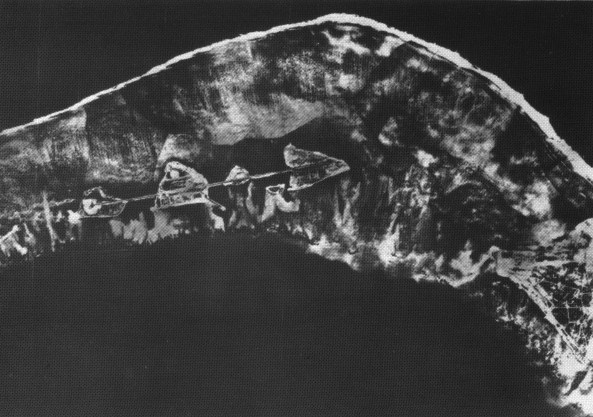
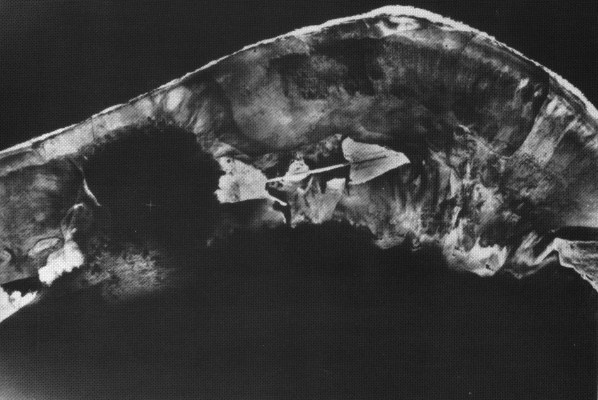
Ivy Mike, the pioneering device based on the Teller-Ulam design, was finally ready for detonation on the Enewetak Atoll (atoll = coral island encircling a lagoon) in the Pacific Ocean: Google Maps, crater (yes, the Elugelab [codenamed Flora] island in the the atoll [not the whole atoll whose radius is 15 km!] ceased to exist and was filled with water; before, after, source).

This device was one of the main reasons we have had peace for many and many decades; Edward Teller should have clearly gotten the Peace Nobel Prize that was jokingly given to the "European Union". How strong was the explosion? And how did the device work?


At the center of the device, there was a cylindrical rod of plutonium, the "sparkplug", that had the task to ignite the fusion reaction. It was surrounded by a natural five-ton uranium "tamper". The external side of the tamper was made of a mixture of lead and polyethylene and these sheets were sending X-rays from the primary to the secondary. The X-rays acted by their huge pressure and temperature.

All the lead, plutonium, and uranium stuff was there just to help the primary actor that was being tested – the cryogenic (=impractical for mobile bombs) liquid deuterium fuel at the very center (plus some tritium) – to get a bit excited and warmed up.

The whole active object, also named "sausage", was encapsulated in 25-30 centimeter thick steel. This whole toy was 54 tons heavy, 619 cm tall, and 203 cm in diameter. With other external components, Ivy Mike weighed over 80 tons (again, that's why it was impractical for mobile weapons). When it exploded, it produced 10-12 megatons of TNT but 77% came from the fission of the uranium "temper" (about 450 kg out of 4.5 tons of the uranium was "burned" releasing the equivalent of almost 8 megatons of TNT) but the remaining 23% may be attributed to fusion. The fireball was 5 km wide and the mushroom went to 17 km altitude in 90 seconds and 30 km in 150 seconds.

Note that 10 megatons of TNT is about 41.84 petajoules i.e. \(41.84\times 10^{15}\,{\rm J}\). Via \(E=mc^2\), that's equivalent to the complete destruction of 0.47 kilograms of matter. Take one-quarter of it (for fusion) and multiply it by 100 to see that about a kilogram of hydrogen was turned mostly into helium or new tritium (and other things).


Via Nuclear Secrecy.COM.

Alexander Ač told us about the energy stored in the otherwise mediocre Hurricane Sandy. His source states that Sandy "contained" – whatever it exactly meant – 0.222 petajoules of energy. It's only larger than the analogous numbers for other, stronger storms because Sandy's figure includes the wind energy from a larger area. If you know how to divide numbers, you can easily calculate that Ivy Mike released the same energy as 188 times the Hurricane Sandy. And it was pretty much produced by one right-wing physicist. That's a simple quantitative explanation why you shouldn't expect right-wing physicists to be overly impressed by the energy of the Hurricane Sandy. ;-)

But if the worshipers of the greenhouse effect and its hypothetical but indefensible effects on the weather events feel humiliated, and they surely should because they are, let me calm them down just a little bit. The research project initiated in 1951 that led to Ivy Mike had a nice name: the Greenhouse. :-D

(Yes, I needed Ivy Mike whose energy was equivalent to 750 Hiroshimas. Hiroshima wasn't enough to beat Sandy; it released about 1/4 of Sandy's energy. On the other hand, NYC rats are stronger than Sandy.)

The crater created by the blast was 3 km wide and 60 meters deep. 80 million tons of rocks were vaporized. The blast didn't proceed as expected – it was two times better i.e. stronger. One pilot who was supposed to pick some air samples died when he ran out of fuel. All elements including Einsteinium and Fermium were produced. A 50-kilometer vicinity of the atoll was substantially radioactively contaminated. You don't want to play with similar toys in the New York City; Sandy is just fine.

Harry Truman who politically supervised the research wasn't the only one. At that time, the Soviets were already working on something similar although their research was arguably not quite independent. Sakharov's Third Idea – the Slavic term for the Teller-Ulam design – got tested in 1955, three years after Ivy Mike (6 times lower yield than Ivy Mike). But already in 1953, one year after Ivy Mike, the USSR tested Joe 4 (0.4 megatons of TNT, 25 times smaller than Ivy Mike) based on a different "Sloika" philosophy. The strongest (thermonuclear or otherwise) man-made explosion ever (so far?) was the Tsar Bomba in 1961. At 57 megatons of TNT, it was 5 times stronger than Ivy Mike and 1,000 times stronger than Hurricane Sandy. Take it, Yankees and weather alarmists. ;-)

Hat tip: Technet.iDNES.cz


P.S.: Just a comment on the energy vs world energy consumption. The Ivy Mike blast may look very large and you could think that it would be great to use it as a generator of energy. But I mentioned that the blast released \(4\times 10^{16}\) joules of energy. It's a lot but the world's annual energy consumption is around \(4\times 10^{20}\) joules so you would have to tame 10,000 Ivy-Mike-like blasts a year to replace the existing sources of energy! But you could imagine it's doable. Forget about peaceful thermonuclear power plants and use a blast to raise a lot of matter to some altitude, or heat it, or something like that. 30 such Ivy Mike blasts a day may produce the electricity for the whole mankind. ;-)
Read More
Posted in climate, fusion, missile, science and society | No comments
Older Posts Home
View mobile version
Subscribe to: Posts (Atom)

Popular Posts

  • Likely: latest Atlantic hurricane-free date at least since 1941
    Originally posted on September 4th. Now, 5 days later, it seems that no currently active systems will grow to a hurricane so the records wi...
  • Amazon: 3D printers below $1,200
    When Howard Wolowitz bought a 3D printer to print figures of himself, Rajesh Koothrappali, Bernadette Rostenkowski-Wolowitz, and other heroe...
  • New iPhone likely to have a fingerprint scanner
    One year ago, Apple bought AuthenTec , a Prague-based security company ( 7 Husinecká Street ), for $356 million. One may now check the Czech...
  • A universal derivation of Bekenstein-Hawking entropy from topology change, ER-EPR
    I have been intrigued by topology change in quantum gravity, especially its Euclidean version, for 15 years or so. Since the beginning, I li...
  • Valtr Komárek: 1930-2013
    U.S.: As predicted and discussed on TRF exactly 3 months ago , Ernest Moniz became the new U.S. secretary of energy. Valtr Komárek died to...
  • Spanish train crash: quantifying the acceleration
    A tragically motivated homework problem in mechanics Chances are that you have already seen the dramatic video of the Wednesday Santiago de ...
  • An apologia for ideas from Hawking's BH bet concession
    In Summer 2004, Stephen Hawking conceded his and Kip Thorne's bet against John Preskill: Preskill was the only one among the three who s...
  • Confusions about the relationships of special relativity and general relativity
    Sabine Hossenfelder wrote about the confusions surrounding the relationship of Einstein's 1905 special theory of relativity and Einstei...
  • Anthony Watts' television channel
    Al Gore has a new TV competitor Last year, Al Gore's Climate Parody Day spent millions of dollars and attracted a few thousand viewers ...
  • A slower speed of light: MIT relativistic action game
    In the past, this blog focused on relativistic optical effects and visualizations of Einstein's theory: special relativity (download Re...

Categories

  • alternative physics (7)
  • astronomy (49)
  • biology (19)
  • cars (2)
  • climate (93)
  • colloquium (1)
  • computers (18)
  • Czechoslovakia (57)
  • Denmark (1)
  • education (7)
  • Europe (33)
  • everyday life (16)
  • experiments (83)
  • France (5)
  • freedom vs PC (11)
  • fusion (3)
  • games (2)
  • geology (5)
  • guest (6)
  • heliophysics (2)
  • IQ (1)
  • Kyoto (5)
  • landscape (9)
  • LHC (40)
  • markets (40)
  • mathematics (37)
  • Middle East (12)
  • missile (9)
  • murders (4)
  • music (3)
  • philosophy of science (73)
  • politics (98)
  • religion (10)
  • Russia (5)
  • science and society (217)
  • sports (5)
  • string vacua and phenomenology (114)
  • stringy quantum gravity (90)
  • TBBT (5)
  • textbooks (2)
  • TV (8)
  • video (22)
  • weather records (30)

Blog Archive

  • ▼  2013 (341)
    • ▼  September (14)
      • Likely: latest Atlantic hurricane-free date at lea...
      • Democrats of Europe, wake up!
      • Confusions about the relationships of special rela...
      • Yo-yo banned in Syria
      • Snowden: Internet encryption useless against eyes ...
      • A universal derivation of Bekenstein-Hawking entro...
      • Nathaniel Craig's State of the SUSY Union address
      • Did soot melt glaciers in the 19th century?
      • 16 out of half a billion: elite Calabi-Yau manifol...
      • Lev Pontryagin: 105th anniversary
      • The 50 to 1 project
      • Ukrainian ex-porn star wins legal residence in Cze...
      • An apologia for ideas from Hawking's BH bet conces...
      • Feminists demand gender quotas for bodies buried i...
    • ►  August (42)
    • ►  July (36)
    • ►  June (39)
    • ►  May (38)
    • ►  April (41)
    • ►  March (44)
    • ►  February (41)
    • ►  January (46)
  • ►  2012 (159)
    • ►  December (37)
    • ►  November (50)
    • ►  October (53)
    • ►  September (19)
Powered by Blogger.

About Me

Unknown
View my complete profile