TheReference

  • Subscribe to our RSS feed.
  • Twitter
  • StumbleUpon
  • Reddit
  • Facebook
  • Digg
Showing posts with label biology. Show all posts

Thursday, August 22, 2013

Chinese medicine is carcinogenic

Posted on 4:29 AM by Unknown
The following insights look particularly ironic and make me think about the prescientific way of analyzing Nature.

One of the most omnipresent chemical compounds in Chinese herbal medicine have been aristolochic acids (AA) which are found in wild ginger, pipevines, and other long tubular flowers. AA I is almost omnipresent in Aristolochia species.


This European Asarum edition of wild ginger almost looks like a tumor itself.

The three hexagons plus a pentagon in the chemical formula don't look particularly healthy to me. ;-) But just to be sure, not all polycyclic compounds such as AAs are aromatic; aromatic compounds are only those whose ground state ket vector is a linear superposition of the formulae with several distributions of the single and double C-C/C=C bonds so that it's more accurate to indicate the alternating bounds by a circle inside the polygons. This allows the molecule to stregthen the binding relatively to the non-aromatic case and this also tends to make the compounds unhealthy. It's sort of remarkable that this class of organic compounds with an interesting two-state quantum mechanical effect were already named by August Wilhelm Hofmann in 1855. Some people are able to get very far in quantum mechanics without even knowing the symbol \(\ket\psi\). ;-)

For quite some time, the compound has been known to be carcinogenic – I didn't know about it – and probably more efficient in causing the disease than the UV radiation and smoking. As such, it's been banned in many Western countries. The tumors appear in the urinary tract, kidneys, and liver. The compound is probably behind the Balkan endemic nephopathy (nephro- means "related to kidneys").

A new paper
Genome-Wide Mutational Signatures of Aristolochic Acid and Its Application as a Screening Tool (Science)

Scientists Find Link Between Aristolochic Acid And Liver Cancer (Asian Scientist, review)
by Song Ling Poon and dozens of Taiwanese and Singapore-based co-authors was apparently able to identify some genetic fingerprints of the mutations caused by the compound which may turn out to be very useful.


The Chinese shamans and their consumers, much like many other pre-scientific cultures, must have been able to identify certain, sufficiently strong and speedy, influences of the plants. Without science as we know it, many cultures – and even animals that lived long before humans – must have been able to identify poisonous plants as well as those that are helping you quickly enough (at most days?) in certain conditions.


But I would say that whenever the impact was delayed by more than weeks, they must have been lost. Their memory wasn't good enough. I suspect that they also believed that no effect that took longer than two days (needed for the food absorbed through the mouth to get out of your body via another hole) could ever be relevant. They obviously didn't evaluate the consumers of their ancient drugs and other remedies statistically, and so on.

So I guess that many such herbal medicines may have determined – at least approximately – which spices and other plants have antimicrobial properties because this effect may be fast and visible. On the other hand, it's likely that carcinogens were completely invisible to the primitive methods of the ancient Chinese folks and other sufficiently primitive tribes.

In some cases, the plants may have been helpful by accident. In most others, they neither hurt you nor help you. And there are apparently also cases in which you may be recommended a plant that is downright harmful – and very harmful, in fact.

The latter situation is particularly unfortunate and you may blame it on the low statistical significance or speed of the impact of the plant. Science has learned to identify all these things systematically. More importantly, the ancient believers viewed a story told by another human (an older relative etc.) to be at least equally important as your direct empirical experience. Science has learned to totally ignore the stories.

So while the ancient people wouldn't notice (with the reliably correct sign) a plant unless it "immediately and visibly" helps you or hurts you, science got good in identifying various "signals" that are hidden in the noise. We could say that the modern medicine research got "too obsessed" with the asymmetries. This obsession could be described as the "opposite bug" than what the Chinese herbal medicine has suffered from.

What I mean is that we can see lots of medicine research papers in which some 2-sigma or so signal is spotted and despite this very low confidence level which makes it extremely likely that the apparent signal was just a fluctuation, such papers often penetrate to the general "scientifically literate" culture or even to further research papers.

For example, my reading of the literature indicates that there exists no really solid evidence (at least 5 sigma, for example) that the second-hand smoking is harmful (in particular carcinogenic). If the original 2-sigma-like papers claiming that the passive smoking should be harmful were right, we would already be surrounded by totally convincing papers with much higher confidence levels because the research and surveys have grown by a huge factor from the first "hints" that the passive smoking should have been harmful. Five-sigma papers should be almost trivial to encounter these days. But they seem to be absent, reinforcing the opinion that the original claims were bogus and the health influence, if one exists, is far weaker and more subtle than originally thought.

Correct me if I have missed some important developments.

Of course, the second-hand smoking is sort of a "politically interesting" topic because everyone is either a smoker or a non-smoker and cares about the social interactions with the other group and the groups' "human rights". But there are arguably many "politically neutral" wisdoms that don't irritate anyone but that are still incorrect even though many people still believe it.

It could be interesting if someone were able and willing to cut through the vast medical literature and simply pick the results that have only been achieved with robust methods and at a confidence level that is appropriate in hard sciences. Otherwise while we've learned many things that were misunderstood by the ancient Chinese healers, we may still be believing lots of superstitions that will only be corrected by a more intelligent mankind in the future.
Read More
Posted in biology, science and society | No comments

Wednesday, August 14, 2013

Arnold Schwarzenegger orders gas chambers for some conservatives

Posted on 10:59 PM by Unknown
...with his thick Austrian accent...

The Terminator's comments at the National Clean Energy Summit were... unfortunate.

According to the Huffington Post (via Junk Science and Climate Depot), he has proposed a final solution to some disagreements with his opponents that seems to be highly popular among famous Austrian-born expats (let me not mention a former German chancellor by his name), perhaps even more popular than their irrational opposition to peaceful nuclear energy:
Speaking of greenhouse gas deniers: "Strap some conservative-thinking people to a tailpipe for an hour and then they will agree it's a pollutant!"
An interesting but not original (as visitors of a camp in Poland know) technique. But will it achieve what the ex-governor believes that it will achieve? Will the conservative-thinking people agree that CO2 is a pollutant?


Arnold admitted he used to be a big admirer of his countrymate Adolf and has been lying about this relationship for decades.

I don't think so. It seems more likely that they will agree with nothing because they will be dead and dead people can't agree with anything. Instead, Arnold Schwarzenegger will be tried for crimes against humanity – and I guess that the judges would agree that this method to terminate the lives of some conservative-thinking people is a crime against humanity. He will be shown that the Terminator's being human is a film propaganda and his abilities to escape justice indefinitely are movie fantasies.

Moreover, their death won't have anything to do with CO2. Why?


Open the Wikipedia's definition of exhaust gases – this encyclopedia is unlikely to be conservatively biased – and you will see the following:
Composition

The largest part of most combustion gas is nitrogen (N2), water vapor (H2O) (except with pure-carbon fuels), and carbon dioxide (CO2) (except for fuels without carbon); these are not toxic or noxious (although carbon dioxide is generally recognized as a greenhouse gas that contributes to global warming). A relatively small part of combustion gas is undesirable noxious or toxic substances, such as carbon monoxide (CO) from incomplete combustion, hydrocarbons (properly indicated as CxHy, but typically shown simply as "HC" on emissions-test slips) from unburnt fuel, nitrogen oxides (NOx) from excessive combustion temperatures, ozone (O3), and particulate matter (mostly soot).
Carbon dioxide, while a greenhouse gas, is not toxic and it is not noxious. It's probably carbon monoxide that will be responsible for the genocide. Too bad that Arnold Schwarzenegger didn't attend an elementary school during George W. Bush's administration because the "No Child Left Behind" program was firmly in place. He didn't have to become a child who was left behind and a walking confirmation of the stereotype that people with his physique are stupid and redundant piles of pork and related proteins – and be sure that I used to think that he was much, much more than that.


The Wikipedia page linked to above also describes the composition of the exhaust gases. In average, they contain something like 71% of nitrogen, 14% of CO2, 12% of water vapor, and 1-2% of carbon monoxide. Trace elements are below 1%.

You see that the nitrogen content is approximately right. The concentration of CO2 is a bit too high. The air that we exhale contains 4% of CO2 so the exhaust gases are about 3.5 times "richer" in that gas. However, on the percentage basis, it is not such a huge difference. CO2 becomes detrimental to life at concentrations about 5% – the atmospheric concentration is 0.04%, more than 100 times lower. Sensitive individuals start to feel dizzy at concentrations of CO2 around 1%, about 25 times higher than the current atmospheric concentration.

So the excess of CO2 would surely be enough to threaten your life after minutes or an hour, to say the least. But it is far from being the main property of the composition that would cause your death.

You may notice that the exhaust gases don't contain any oxygen. It's been used to burn the fuel, stupid. You should really be getting at least about 20% of oxygen (100% is no problem, as astronauts know), otherwise you're not getting an important gas. In fact, many of the health problems appearing in elevated CO2 concentrations are incorrectly attributed to the excess of CO2 even though the main problem is actually the shortage of oxygen.

Most importantly, the exhaust gases are said to contain 1-2% of carbon monoxide, CO, which results from "imperfect combustion" (perfect combustion ends with the perfectly harmless oxide of carbon, the carbon dioxide). You see that the concentration of CO in the exhaust gases is just 7-14 times lower than the concentration of carbon dioxide.

What are the dangerous concentrations of CO? This page on CO poisoning says that concentrations 100 ppm i.e. 0.01% and greater can be dangerous to human health. So the exhaust gases contain 100-200 times greater concentrations of carbon monoxide than the dangerous ones while 14% of CO2 is just 3.5-14 times greater than the dangerous concentrations of CO2, 1%-5% (CO2 only starts to be dangerous at 100-500 times higher concentrations than CO).

You see that the carbon monoxide content is about an order of magnitude more lethal than the carbon dioxide content. Something like 85-98% of the death of the conservative-thinking person should be blamed on carbon monoxide, a very different gas than carbon dioxide. The high content of water vapor isn't a good thing, either, but the complete absence of oxygen is obviously much worse.

It's mostly carbon monoxide that would kill the people in the gas chamber. Let me also mention that this toxic gas is not considered a greenhouse gas. First, its diatomic structure is too simple and makes its infrared spectrum very limited. Second, carbon monoxide is short-lived in the atmosphere due to its reactivity and solubility. The most evil gases are not greenhouse gases while the main greenhouse gases (water vapor and carbon dioxide) are some of the healthiest and most harmless gases around. The relationship between greenhouse-ness and toxicity is exactly the opposite than the alarmist demagogues love to say.

So if the ex-governor were able to realize his dream and attach the conservative-thinking people to his gas chamber and if he were able to claim that the people were murdered by carbon dioxide, you would know that the court system has probably been hijacked by Arnold's murderous ideology because science says something completely, completely different.

Most importantly, CO2 produced by the cars, factories, and other human activities – and by all breathing animals in Nature, among other natural sources – is definitely not a pollutant simply because this production of CO2 only leads to concentrations (and at least, for thousands of years will only lead to concentrations) that are not harmful to anyone and they're actually beneficial to all plants on Earth.


Arnold Schwarzenegger Exhaust, a stupid video formally related to the topic of this blog entry

To summarize, Arnold's "science" is a complete crackpottery which means that the only contribution he is offering to the mankind is his desire to murder people who are vastly smarter than he is.

And that's the memo.
Read More
Posted in biology, cars, climate, politics, science and society | No comments

Wednesday, August 7, 2013

Ostragene: realtime evolution in a dirty city

Posted on 9:21 AM by Unknown
Ostrava, an industrial hub in the Northeast of the Czech Republic, is the country's third largest city (300,000). It's full of coal mines and steel mills. ArcelorMittal is the world's largest steel producer and bought a major facility there. The air contains products of a chemical plant and some junk blown from the nearby Poland, too. The history of hardcore pollution in the region goes back to the 19th century.

Just to be sure, we're talking about real toxins, not bogus pollution like CO2. The air often contains things like benzo(a)pyrene, a carcinogenic polycyclic aromatic hydrocarbon, in concentrations severely (e.g. by 700%) exceeding the allowed maxima.


Yesterday I learned something I should have heard about in late 2011 but I had to miss it. But let me get to the point. One should expect that with this much benzo(a)pyrene, people in Ostrava will get many more tumors than those in Prague, for example. But they didn't. The life expectancy seems to be a bit lower in Ostrava but this difference seems to be associated with cardiovascular diseases. A paradox.


The first word in the title leaked the resolution to the paradox. Many/most people in Ostrava developed a special mutation of a gene whose task is the correction of errors in the DNA. The gene used to be known as XRCC5. The Ostrava folks carry a more active version of this gene.


This mutation seems a bit comical, like a Nature's clever and witty trick, and the idea of such a mutation closely resembles the theme of the 1988 movie by later famous film director Mr Jan Svěrák, The Oil Gobblers (3 parts), about a new (fictitious) species that evolved in dirty environments and that really loves to drink and eat petroleum and various other yummy things.

The idea of such a mutation may sound funny but Nature seriously works like that!

The mutation has some negative side effects – it makes one's aging process a bit faster and may speed up the cardiovascular diseases which is why the people with this mutated gene have a lower life expectancy, by about 2 years, but this is probably still a smaller reduction of the life expectancy than what the benzo(a)pyrene would steal from an unmutated human being.

You will probably agree that XRCC5 isn't a catchy name. Well-known Czechia's songmaker Mr Jaromír Nohavica who lives in the region and possibly has the mutation as well has invented a more colorful name for the mutation – Ostragene (in Czech, it's simply "Ostragen"). Needless to say, this word constructed by the combination of the words "Ostrava" and "gene" sounds sexy also because it is so similar to "estrogen". The poet was successful and everyone, including the medical experts, began to use this terminology.

A few years ago, I was lucky to be in Nice and to hear the world's leading defenders of the Intelligent Design paradigm advocating their framework to explain the origin of species – well, mostly their criticisms of Darwin's theory. As you can guess, I ultimately thought that every single criticism had a bug, perhaps the very specific bug that I saw in them, but you may be sure that their knowledge of the species was impressive and the arguments were rather sophisticated.

Some of the arguments against evolution dealt with the speed of mutations - see also an old TRF interview with Franziska Michor. As far as I could say, the argument was almost perfect but it did contain a wrong assumption or oversimplification that was needed for the argument to go through, namely that the speed of mutations is dictated "from above" and may be predetermined by the author of the argument. In reality, even the speed of mutations is something that depends on your DNA and Nature is trying various experiments to help the (mutated) species survive in the given environment. This includes Ostrava-like suppression of the mutation rate whenever it seems like the frequent mutations are "forced upon the organisms" by the environment but they're not helpful to adapt to changes because the environment is nearly constant; and on the contrary, Nature may prefer mutations and organisms with a faster mutation rate whenever it seems like they need to adapt quickly and it's a better idea to try many mutations – Nature's individual experiments.

While I have mentioned top creationists as those who overlook the dynamical character of the mutation rate, it's really the environmentalists who are making this mistake – and many other mistakes – most frequently. Quite generally, they underestimate if not completely deny Nature's ability to adapt.

If someone understands evolution at the technical level, I would love him or her to explain to me how long a time it takes for a mutation like Ostragene to conquer much of the city. The original mutation had to be pretty random – i.e. unaffected by the environment, right? So it must have been due to the environmental pressures that the mutation started to spread in Ostrava and not in Prague, for example, am I right? Otherwise we would be back to the flawed Lamarckian evolution, I guess.
Read More
Posted in biology, Czechoslovakia, science and society | No comments

Saturday, July 27, 2013

Some amazing technological advances

Posted on 11:07 PM by Unknown
I am getting lots of similar news and sometimes I collide with some of them in the media. Sometimes they sound amazing.

First, MIT has developed a perfect mirror – a material that reflects electromagnetic waves without any losses.


Now, Tesla Motors and Colorado's company SpaceX believe that they can build an amazingly fast superhighway of evacuated tubes where you can drive from California to NYC in an hour.


A combination of magnetic levitation, vacuum would allow minivan-sized capsules to travel up to 6,000 kph and the replacement for the EastCoast-WestCoast air ticket would cost just $100.


Slingatron is a mechanical hypervelocity launcher, a railroad to space, by HyperV Technologies Corp. You may contribute your dollars to that project but this particular project – endorsed by Freeman Dyson – seems a bit premature if not amateurish to me.

Tel Aviv is building SkyTran, a futuristic public transportation system where people are transferred much like the packets on the Internet (physical internet).


The military and navy aren't sleeping, either.


DARPA, the U.S. defense research unit, is planning to build Hydra, an undersea drone carrier.


If you want something that can be inserted into your pocket, what about a mobile smartphone DNA analysis?


Well, the Biomeme's device has a docking station performing a polymerase chain reaction. The results may be sent to the cloud in real time and it's not hard to imagine a speedy system that immediately informs one about diseases by seeing their DNA or RNA signatures.

Let's continue with the medical miracles. Many people have transparent brains – because nothing ever gets absorbed into them. But what about a transparent brain that does its job? Stanford folks developed Clarity, a hydrogel process that makes the mice's brain transparent.


Mice are very helpful collaborators the medical researchers. They implanted fake memories into mice.

Geeks may now use Nerdydata.com, a search engine the focuses on the source code. Habitable planets may be out there but they are very far. We can't get there anytime soon.

3D printing will explode next year as some key patents expire. Arcam AB will grow as well, a Swedish metal 3D printing company. 3D Systems buys a metal printer. Now, people will also be able to print in liquid metals. Boeing is switching to PrintRite3D. 3D printing may change supply chains.


Kawasaki's stainless steel robotic arm has seven degrees of freedom.

Some important paperwork was signed 3 days ago for the Hawaii thirty-meter telescope.

Chromecast, Google's little and cheap $35 cork that you USB-insert into your stupid HDMI TV to create a smart one has been sold out.

It will cost you nothing if you want to detonate a nuclear bomb in a city of your choice. Google Earth is everything you need. ;-)

Impressive technological revolutions are occurring around us. They're driven by a tiny portion of the human population – and those behind each of them are often very specialized, anyway. I am afraid that we're entering a world in which the bulk of the mankind doesn't know what's going on around them which is bad not only because knowledge is good but because the people may be cheated in many new ways. Maybe it's not such a bad thing, however.

Via Viktor Kožený, Czech media, U.S. media etc.
Read More
Posted in biology, missile, science and society | No comments

Tuesday, July 23, 2013

Mechanical characters mass-produced by Disney, cyborgs at Harvard

Posted on 11:33 AM by Unknown
Apologies to TRF readers – I was too busy these days: traveling, swimming, walking, and more. Here's a recreational blog entry. In the following video, you may see some cute mechanical puppets displaying some highly realistic motion:


In fact, Disney Research has a whole infrastructure to mass-produce toys of various kinds.


If that's too mundane and old-fashioned a piece of technology for you, let's try something else.


Nature Materials just published a paper
Macroporous nanowire nanoelectronic scaffolds for synthetic tissues
by a Harvard-HMS-MIT collaboration. They develop a method to fabricate "scaffolds" that may be later filled with cells and become a tissue. You may ask where the biological activity ends and where the electronic activity begins and the very purpose of this engineering is to make the boundary fuzzy and hard to localize.

The photograph of Cyborg Witten, one of the most famous cyborgs who also wrote the paper discussed in the previous blog entry, was taken by Warren Siegel.

See reviews of this ethically provoking if not controversial advance at 33rd Square and a press release at EurekAlert.

Hat tip for both developments: Viktor Kožený, an enthusiastic follower of all these and related technologies, thanks
Read More
Posted in biology, science and society | No comments

Tuesday, June 18, 2013

Most species originate in the tropics

Posted on 8:05 AM by Unknown
Yesterday was the first really good day of 2013 to swim in a pond – two months later than in 2012 – and today is the first supertropical day of the otherwise cloudy year 2013 with temperatures reaching 35 °C in Pilsen where the warmth has its headquarters. Prague was colder but 33.5 °C was still enough (by 0.3 °C) to beat the record for this day which didn't occur in 2012 but in... 1934. ;-) A tropical topic may therefore be appropriate.

Because Slovak geologist Mr Adam Tomášových is among the 8 authors of the paper, the science section of the Slovak daily Sme.sk reviewed the article
Out of the tropics, but how? Fossils, bridge species, and thermal ranges in the dynamics of the marine latitudinal diversity gradient
written by David Jablonski et al. and published in PNAS. See also futurity.org.


They looked at three slices of Cenozoic (from 66 million AD through now) and decided that most marine genera originated in the tropics. You may view the paper as a followup to the "out of the tropics" mechanism coined by Jablonski and others in 2006.


They were also interested in the way how these tropics-born species migrate into the moderate zone. A heat wave is probably necessary for such a migration while intraspecies adaptation and the diversification rate of a species is helpful to allow a new species to migrate out of the tropics.


I think that most of us will find these statements somewhat uncontroversial and plausible. Tropics is where the concentration of life is maximized. Moreover, the Sun and heat probably tends to increase the mutation rates over there which is why the percentage of the species originated in the tropics is likely to be even greater, probably much greater, than the percentage of the individual organisms that actually live there today.

Tropics are the place with the highest biodiversity and it's no coincidence. Their research shows that this has been the case at many distant moments in the past, too.

An interesting concept promoted by the paper are the bridge species. A seemingly sensible yet naive assumption known as "niche conservatism" is that species tend to live in similar habitats as their relatives. However, according to this paper, many jumps (in some analogy, jumps over the river) have occurred and they were extremely important. For these jumps to be possible, one needed one of the rare special species, the bridge species, that allowed life to spread to less hospitable (essentially cooler) places. Just to be sure, "niche conservatism" will be obeyed in most cases if you look at random animals and their ancestors. However, this "niche conservatism" assumption prevents you from explaining the origin of the bulk of biodiversity on Earth.

There are only one or two bridge species per evolutionary lineage – a small percentage of all species – and all these bridge species seem to have originated in the tropics themselves. The paper also finds something you may view as counterintuitive: the most widespread species are not those that tolerate the largest temperature swings. In fact, those that tolerate a narrow interval are (at least in the case of bivalves) the most widespread ones. But it's not so illogical as you might think because the narrow tolerated interval may be adjusted by evolution, too. Moreover, the tropics represent a significant part of the Earth and the temperature over there is rather constant so too much tolerance isn't needed.

The global warming alarmist censors must have misunderstood the paper completely because they couldn't stop the publication of this paper despite the fact that according to these loons, liars, and demagogues, a warmer weather is hurting (and is probably going to destroy) life on Earth. ;-)

More seriously, if the tropics offer the best temperature for life on Earth, we may calculate how much the temperature should rise (uniformly over the globe: an assumption) for the life's well-being to be optimized over the globe. Clearly, it would be better for the optimum temperature to be found in the moderate zone – which has a greater area and which is currently about 20 °C cooler than the optimum tropics. It follows that the optimum global temperature rise for life is at least 20 °C. I say "at least" because there are no available data that would directly or indirectly imply that the optimum temperature for life isn't even higher than the current temperature of the tropics. Compare this scientific fact – that a 20 °C temperature rise would be beneficial for life – with the insane fearmongering about a 2 °C warming (from which only 0.7 °C or so was realized in the last 100 years).
Read More
Posted in biology, climate, geology | No comments

Friday, May 10, 2013

Why we should work hard to raise the CO2 concentration

Posted on 10:27 AM by Unknown
Many texts about the climate and related issues are highly, boringly repetitive. I believe that a typical person who regularly follows the research and debate about similar issues has heard 99% of the things that are written about the climate change or carbon dioxide etc. Even the research that claims to be new is often just rehashing some memes that have been around – and we usually have very good reasons to suspect that the results of the research were decided before the research was performed.


But there are some good exceptions. Two days ago, ex-moonwalker Harrison Schmitt and physics professor Will Happer of Princeton wrote an opinion article for the Wall Street Journal from which I could have learned some new things:
Harrison H. Schmitt and William Happer: In Defense of Carbon Dioxide

The demonized chemical compound is a boon to plant life and has little correlation with global temperature.
The basic theme of the article is simple and most of us learned it as fifth-graders: CO2 is primarily the plant food while its other implications for Nature are negligible in comparison. Humanitarian organizations should work hard to help the mankind to increase the CO2 concentration and it's surprising that virtually all of them are failing to do so.


Needless to say, the article was greeted with a highly nervous reaction from the anti-scientific left-wing extremist sources. They must think it's a blasphemy to remind anyone that CO2 is the key compound that plants need to grow – and, indirectly, that every organism needs to get the food at the end. See, for example, the hysterical reactions by Climate Science Watch, the lousy and badly biased astronomer Phil Plait, anti-Fox-News attack dog organization Media Matters for America, and many others. Many of them seem to literally say that it's been disproven that plants need CO2 to grow; I kid you not. The insanity of certain people who put ideology (and not just any ideology: I mean a highly pathological ideology) on the first place has no limits.

Mr Plait and others, please, try to gradually get used to the fact that we are past the peak global warming hysteria. The elementary parts of common sense, e.g. the realization that carbon dioxide's impact on Nature as a plant food is many orders of magnitude more important than the role of carbon dioxide as a greenhouse gas, will be returning to all segments of the society and you will be increasingly recognized as kooks if you deny such facts about 101 botany, 101 economy, and 101 ecology, even among the people whom you expect to be "ideologically obedient". Your position is totally unsustainable in the long run and even the medium run.


The (for me and others) new insights that the authors presented were differences between C3 plants and C4 plants. The latter evolved to cope with lower CO2 concentrations but they still have to pay some price.

In both cases, plants absorb CO2 through stomata in their leaves and they need a very large amount of water to grow. A higher CO2 concentration allows them to reduce the number of stomata and save water, if I simplify things a bit. So one may say that a higher CO2 helps the plants to deal with the shortage of water.

Today, the average CO2 concentration reached 400 ppm or 0.04% of the volume (or, equivalently, of the number of the molecules in the air because the air is a nearly ideal gas) "today". The mankind will reach a maximum that is much higher, perhaps 600-1,500 ppm between 2050 and 2300. I don't know any details. No one knows them.

But if those future generations stop pumping CO2 into the air, its concentration will drop dramatically. These days, Nature absorbs about 2 ppm worth of CO2 every year from the atmosphere; it's because the "excess CO2" above the equilibrium value which is about 280 ppm for our temperature is about 120 ppm. If the excess is gonna be 600 ppm, like in 880 ppm, it's very plausible that Nature will be eager to absorb five times more, i.e. 10 ppm from the atmosphere every year. That could be described as a nearly 1% drop of CO2 in the atmosphere per year which could reduce the efficiency of agriculture by 0.5% or so per year.

It's not too much but it's not negligible, either. If their technological tricks are already maximized, they could easily find out that the dropping CO2 is an order from Mother Nature that the population should drop by 0.5% a year. The Earth's ability to feed the mankind may start to drop at that point. 0.5% isn't a cataclysmic population decrease and it may be respected without mass starvation, by a lower birth rate. But it would still be annoying.

Nowadays, we enjoy CO2 concentrations growing by 2 ppm i.e. 0.5% a year and this increase contributes a non-negligible part to the increasing efficiency of the agriculture. I hope that when people are forced to get used to the dropping CO2, they will either find a way to mitigate this unwelcome evolution – e.g. by burning lots of biomass or something else – or they will have some other tricks.

For example, in 100 years, most of the agriculture may take place in some huge "greenhouses" (which are more useful if the CO2 concentration in them is kept at elevated levels). What some nations are doing about beating Nature's limitations on agriculture is impressive. Open the new Google Earth Engine with the Landsat Annual Timelapse 1984-2012. You may see the satellite pictures of any region on the globe to check how it was changing during the last three decades. You are offered some real local catastrophes, like drying of the Aral Sea (or a lake in Iran), some changes that are overinterpreted as tragedies although they're really not, like Amazon deforestation and the retreat of a glacier in Alaska, but also examples of some impressive human activities.

They include expanding coal mining in Wyoming – I don't like it too much; and Dubai coastal expansion which is impressive at any rate. But my winner is the Saudi Arabia irrigation. What these Saudis managed to do with the desert is amazing. Look at the nicely ordered crop circles! The diameter of these circles is almost 1 kilometer. Cool. With enough energy, similar things can be built in Sahara and elsewhere, too. I see no reason why the average population density sometime in the future shouldn't exceed the current population density in the Netherlands – 500 people per square kilometer – which would mean that the world population may rather easily surpass 50 billion at some point (many centuries in the future).

I don't claim that I like the idea – large fields and forests where no one annoys me for hours in the afternoon usually seem more pleasing to your humble correspondent than overcrowded, loud areas ;-) – but liking something is a totally different issue than expecting something to take place!
Read More
Posted in biology, climate, science and society | No comments

Tuesday, April 16, 2013

Panspermia follows from Moore's law

Posted on 7:09 AM by Unknown
Just several years ago, when this blog already existed, I got converted to the idea of panspermia which says that the earliest forms of life were born somewhere in outer space before the Earth was formed – and they just found Earth to be a particularly hospitable destination where they could further evolve and flourish.


Now, the Physics arXiv Blog discusses the preprint
Life Before Earth
by two biologists, Alexei Sharov and Richard Gordon, who aren't affiliated with any "top theoretical universities" that brings us a cool new argument in favor of the panspermia paradigm.


The argument is based on a computer science meme, Moore's law, that claims that the number of transistors on a circuit is exponentially increasing with the doubling time that is either 18 or 24 months or so.


Just for the sake of completeness, this is how the number of transistors grew from the 1970s:


Growing by a factor of 1 million (20 doublings) in 40 years translates almost exactly to a 2-year doubling time.

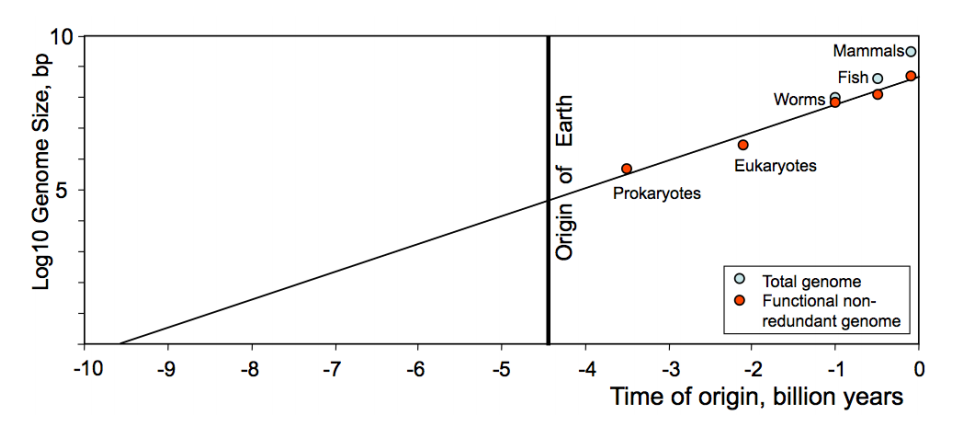
I think you will agree that the line – with a logarithmic y-axis – is indeed remarkably straight. The case of biology is designed to be as similar as possible. Instead of transistors, they count the functional genome's base pairs (bp). The result looks like this:


The functional non-redundant genome size apparently grows 10-fold in a billion of years or so.

In particular, the red dots are ordered truly linearly – the growth is exponential – and there's no doubt that if you extrapolate the number back to "the origin of Earth" 4.7 billion years ago, you still get a genome size above 10,000 base pairs.

The most obvious criticism you may raise is that this naive straight-line "Moore's law" just fails. The line is allowed to bend. Equivalently, the explosion of the genetic information in an animal could have grown exponentially but with a much shorter doubling time when life was really getting started. Maybe. However, note that you could raise the same objection in the case of the integrated circuits but Moore's law seemed OK even when computers were very, very young.

Even when Moore's laws in this particular form – one could of course guess that other precise quantities grow exponentially but this "transistor/base pair count" seems to be particularly well-behaved – are correct, a question is whether we may "prove" or at least find an argument that "explains" why the doubling time should be constant. I don't have such a "theoretical proof" and I am interested in it if you know one.

However, as I have previously stated, there is a reason why I think that the idea that "all steps to life had to occur on Earth" is probably wrong. It's just unnecessary and based on a one-size-fits-all egalitarian reasoning that has obvious limitations.

If you believe that even short DNA molecules were first born on Earth, you probably defend such a viewpoint by pointing out that our blue, not green planet is so unusually hospitable and obeys the conditions we need for life. So it had to be here.

This claim seems to treat the word "life" in a very sloppy, ambiguous way. It's the higher life similar to ours that needs the oceans to swim in and other achievements that Earth seems to boast and employ to defeat many competing tourist destinations. However, when we talk about the origin of life, we're not talking about the origin of mammals. The latter could have taken place on Earth but that does not imply that the former event had to occur terrestrially, too.

In fact, I find it pretty obvious that the concentration of the habitats to friendly hot spots is becoming more focused as one goes towards the higher life forms. If a professional (=paid) string theorist is picked as the prototype of the highest life form on Earth, its or his or her habitat is confined to several floors at Princeton, New Jersey, Cambridge, Massachusetts, and a dozen of comparably small places that are getting less and less characteristic. These are much more special places than the places where mosquitos and fungi flourish – which is almost everywhere on Earth.

If you revert this "increasing concentration of genetic capital" to reconstruct the distant past, it seems reasonable to think that the "optimum place" for some extremely old, primordial life forms was less localized than the Earth's surface. After all, it's probably not true that these life forms needed a nice amount of planetary gravity – gravity becomes almost irrelevant for very small cells etc. much like it is irrelevant in particle accelerators. Similarly for water etc.

I think that the volume of "cavities in rocks" and similar things that are flying around all stars in the Milky Way is probably higher than the volume right above the Earth's surface where we expected terrestrial life. In particular, even if you insist that the temperature is right, you don't need an Earth-like planet at the right radius that orbits a given star. The rocks may be just enough.

I don't want to be excessively specific about the "less demanding conditions" that the early life could have depended upon because I haven't spent too much time with thinking about all such possible conditions. But I surely do believe the general principle that the primitive life is less choosy and less picky than advanced life. This very general principle is enough for me to prefer the hypothesis that the very early life was born at rather generic extraterrestrial places and it just found the Earth to be a particularly hospitable place for a further evolution.

What do you think?
Read More
Posted in biology, science and society | No comments

Sunday, April 7, 2013

Percival Zhang: cheap hydrogen fuel from any plant

Posted on 12:37 AM by Unknown
Joseph S. has sent me links to articles (e.g. UPI, Forbes) about an energy breakthrough claimed by Percival Zhang, a bio-engineer from Virginia Tech.


He claims to have completed a system of biotechnologies that produce a large enough amount of hydrogen out of plants.


He used the second most important sugar in plants (xylose, the simplest among abundant sugars that is named after wood [in Greek] from which it was first isolated) and some enzymes to prevent the microorganisms from practicing their main hobby – reproduction – which increases the amount of produced hydrogen three-fold or so.


If you have ever cared about rocket propellants (or even hydrogen fuel cell-powered cars), I don't have to explain to you how cutely clean hydrogen is as a fuel. Its oxidation produces something of order an electronvolt per atom, a huge amount of energy, especially if you realize how light a single hydrogen atom is.

Needless to say, it's nearly mandatory for the newspaper articles written about this topic to discuss how "environmentally friendly" this possibility is and how it would reduce the "dependence on fossil fuels". Sometimes, this type of propaganda leads to nearly comical inaccuracies and mistakes in the press releases and articles, for example:
This environmentally friendly method of producing hydrogen utilizes renewable natural resources, releases almost no zero greenhouse gases and doesn't require costly or heavy metals, a university release reported Wednesday.
Well, when you burn the hydrogen, you combine hydrogen and oxygen to produce water – which actually not only is a greenhouse gas but it is the most important greenhouse gas in our atmosphere, one that is raising the average temperature by something like 33 °C. What they wanted to write is that the process releases no greenhouse gases with long residence times (of order decades or longer) – and long residence times are needed for the greenhouse effect to be strong enough and "accumulating". Note that the residence time of water vapor in the atmosphere is estimated as 9 days while the same figure is 30-95 years for carbon dioxide.

At any rate, it would be cool if hydrogen were the stuff in which we store the useful energy. But because fossil fuels – and even biofuels, if we talk about "renewable" fossil fuels – only differ by their replacement of water vapor by another beneficial gas, carbon dioxide, the new technologies must really become cheaper for them to fairly prevail.

Imagine they will. The Forbes article in particular is full of interesting technical semi-details but it also unmasks the attitudes of U.S. secretaries of energy who are expected to wisely support similar research. Both Steven Chu and his successor Ernest Moniz have trash-talked (and in Chu's case, slashed 70% of the funding for) hydrogen fuel cell research because the solutions that existed at that time produced CO2 at the same moment. Their viewpoints seem foolish and unworthy of visionaries, right? It's one of the main points of a proper energy research (and research in general) to show that certain technical assumptions we are making today aren't really necessary.


TriHyBus, a triple hybrid bus from Pilsen.

This is just an example showing how utterly foolish it is for the not-quite-experts in the government to selectively throw large amounts of money to various kinds of fashionable research. Chances are huge that they will throw it to wrong places, hopeless research directions that will get uselessly overfunded, and those promising ones actually end up being overlooked and underfunded, anyway. The main obstacle in this energy research surely isn't the shortage of net funding. Extra funding that is decided by politicians because they have to decide in some way – instead of investors who invest because they were intrigued by a particular idea and are willing to put their own money at risk – is pretty much guaranteed to be nothing else than the waste of the taxpayers' money.

I am not saying that Chu or Moniz are stupid. But general expectations just like the particular evidence above suggests that they – and government bureaucrats in general – just can't see "all promising potential paths to the future" that emerge in an industry as large as the energy industry. When the funding decisions are effectively made by one person and his or her hierarchy, many promising directions inevitably remain underfunded and the bulk of the money is inevitably spent unwisely. The government is 1) narrow-minded, 2) not guaranteed to have some of the most qualified people who are responsible for various decisions (no genuine market competition or natural selection operates within the government to achieve this outcome), and 3) unmotivated to make the decisions really well – carefully yet creatively. These three disadvantages combine to make up the public spending inferior relatively to the spending by the private sector. When we talk about the applied research that is supposed to produce economically attractive results within years or a decade, we should simply leave it to the invisible hand of the free markets as purely as we can.
Read More
Posted in biology, climate, experiments, markets, science and society | No comments

Tuesday, April 2, 2013

UCSC study: sea lions like Backstreet Boys

Posted on 3:14 AM by Unknown
...but the metronome is pretty good, too...

The University of California in Santa Cruz – where I spent the first half of the year 2000 – has done research into the question which mammals aside from humans like Backstreet Boys. And I must emphasize that this is not an April fool's joke.


The winner is Ronan, a sea lion.


You might conjecture – and people have conjectured – that pinnipeds and similar mammals are way too primitive. Unlike humans and parrots – the latter are role models for many humans while they see other humans as their role models, sea lions don't display vocal mimicry.


But vocal mimicry is apparently not necessary to keep the rhythm just like silicon isn't necessary to follow an Al Gore Rhythm. Apparently, even without vocal mimicry, everybody can rock his body. Rock your body right.

The university has also employed a ton of acorns to train squirrels to write papers on loop quantum gravity.
Read More
Posted in biology, music, science and society | No comments

Tuesday, March 19, 2013

Matt Ridley on the greening planet

Posted on 11:08 PM by Unknown
Many of us had serious doubts about the talk claiming that lots of cows will green the deserts. On the other hand, I have almost no doubts about the main points in this 19-minute talk:


Via Bernhard Jordan

The increased CO2 levels, higher efficiency of agriculture in general, and fertilizers in particular allowed the planet to become greener than before.


Matt Ridley offers lots of geographic examples. He also mentions that only nine species that weren't confined to islands (plus Australia) have gone extinct due to humans in the last 500 years. The deceleration of extinctions reflects the main reason why the species were going extinct in the first place: people were just killing them. Quite often, they were doing so for a reason. Environmentalists are not the only reason why we're not doing these things so often today. The existence of artificial replacements is arguably more important.


Other particular examples of the greening of the Earth and of the expanding life come from Sahel, Amazon forest, the U.K., the U.S. East Coast, Svalbard, and others including the island that hosts both Haiti and the Dominican Republic. Haiti is the brown, ugly, and lifeless part of the island because it's been crippled by the "renewable" scumbags.

The technological and industrial development isn't the culprit here: it's part of the solution. Do you agree?
Read More
Posted in biology, climate, science and society | No comments

Monday, March 11, 2013

Greening the world's deserts with lots of cows

Posted on 12:28 AM by Unknown
Since I was a kid, the idea of greening the Sahara desert (and smaller deserts) looked immensely noble to me. Now, Anthony Watts became unusually excited about a particular approach to this goal, one that involves the propagation of cows (and some other, related or unrelated ideas).
A bridge in the climate debate – How to green the world’s deserts and reverse climate change (WUWT)
His excitement was ignited by the following 22-minute L.A. TED talk by Allan Savory:


It may be a good idea to watch it before we discuss it.


First, the talk was very persuasive but at the beginning, I wasn't repelled just by the phrase "reverse climate change" in the title of the talk. My disapproval continued at the beginning of the talk. In the first minutes, Savory said that having lots of people – e.g. 10 billion people – is the biggest problem of a sort, and so on. You probably know that I consider these "population limit worries" irrational.

The Earth hosts more than 7 billion people simply because the people were able to overtake the space, resources, and potential, and the Earth was able to offer them. As soon as at least one condition ceases to hold, the population growth may slow down or get reverted. There's no sign that any "global pressures" of this kind are already acting. The growing population isn't a cause of big problems in nearby future; it's a consequence of having no big problems in the past.

And you may remember some of my estimates suggesting that even with the current technologies and almost nothing new, the Earth could easily host 20 billion people. With the predictable propagation of evolved technologies, 50 billion or 100 billion don't seem to be a problem. Before you say that I am silly, you should realize that you are silly if you claim that these scenarios are impossible. The same invalid "no-go theorem" could have been said at any moment in the history – when the Earth hosted 1 billion people, 100 million people, or even fewer people. None of these predictions had any reasons to be right and none of them was right.


But let me get to the beef of the talk, the positive stuff.

I agree that the desertification is probably the #1 process that negatively contributes to the value of some land. About 2/3 of the Earth's landmass is something that could be called "desert" in a broader sense. The deserts may see lots of precipitation but the soil isn't covered and these huge amounts of water simply evaporate (plus other processes).

Even when there's some grass, the underlying soil may be bare and covered by algae, and this situation still leads to lots of undesirable evaporation. Cattle is generally believed to eat grass and contribute to desertification (methane farts indirectly pump the carbon atoms into the atmosphere which is also bad because the biomass "permanently" leaves the soil). In fact, the speaker himself once determined it would have been a good idea to shoot 40,000 elephants. The desertification got worse. He will carry the bad conscience to his grave, we hear. He decided he had to find a solution.

When he came to the U.S., he was shocked by some arid desert-like national parks. He was told it was natural. He wanted to prove that cattle caused the desertification but he found the opposite. Other "experts" attributed the desertification to unknown processes. Ordinary litter on the surface reduces temperature fluctuations.

He described the healthy ecosystem in which predators force the cattle to run from place to another place and uniformly s*it and p*ss at, or what are the polite verbs, the land. People replaced some of the processes with artificial fires that reduce the dead material and allow the plants to grow. He explains how bad this policy is, not only because the fires produce lots of toxins.

Fine, at 12:20, he proposes to emulate the bunched and running cattle by artificially moving livestock. Lots of it.

The lying grass with feces on it is able to store the humidity and carbon. So in his plan to compensate his genocide of the elephants, Savory is teaching pedagogically talented African women to teach how to bunch the animals and do other things. It seems to work: crop fields increase in regions treated in this way (which involve a five-fold increase of cows). The pictures look impressive. He literally turned deserts to something that looks like the Czech landscape. Sheep in Patagonia did something similar.

At 19:00 he mentions fossil fuels, but thankfully not as the largest problem. He still wants to eliminate fossil fuels but says it won't help. He also claims that the cow-treated de-desertification can lead to the absorption of CO2 and return the concentration to pre-industrial levels which I don't consider to be a good thing but greening 1/2 of the world's deserts would be more important.

I think it's common sense that if this treatment of flocks of animals makes the land locally fertile, they should do so. At the end, the host asks Savory what do the large flocks of animals eat if everything is dry to start with. I didn't understand Savory's answer. His talk was nice but I would still prefer a version of the talk that is stripped of tendentious claims about fossil fuels, the need to reduce the CO2 in the atmosphere, and concerns about the population bomb.
Read More
Posted in biology, climate, science and society | No comments

Friday, February 8, 2013

Nature, Reuters: Amazon forest will thrive due to CO2

Posted on 2:06 AM by Unknown
Alister Doyle of Reuters, Green Optimistic, Mongabay.com, and others dared to blasphemously discuss a heretical paper in Nature,
Sensitivity of tropical carbon to climate change constrained by carbon dioxide variability
by Peter Cox and 6 co-authors.


Their new modeling concluded that the Amazon forest will keep on growing throughout the 21st century, mostly due to the fertilization by carbon dioxide that is going to beat all hypothetical negative terms that some people may want to associate with CO2 or anything else (fires, release of carbon induced by warming, and so on).


It's great that some of these researchers in Earth sciences are slowly learning what an intelligent child knows before she leaves the kindergarten: that plants eat carbon dioxide as their food and given a sufficient access to water and a sufficiently high temperature, the availability of this nutrient is by far the most important factor that decides about the growth of plants.

The new paper is a sign of a good development especially because the lead author, Peter Cox, was also the leader of a team that published a 2000 paper in Nature that bizarrely predicted that "global warming"-related phenomena would actually shrink the amount of carbon stored in the Amazon forest.

The amount of carbon that will be added to the Amazon forest by 2100 is a multiple of tens or hundreds of billions of tons. It's estimated that one Celsius degree of warming releases 53 ± 17 gigatons of carbon to the atmosphere but this individual term is unobservable because it's added to – and beaten by – much larger positive terms related to fertilization.

Some other general science news

After 4 years, the new largest known prime number was found. It is a Mersenne prime with more than 17 million digits. The progress from the previous one doesn't look spectacular – four years ago, the record holder had almost 13 million digits.

Next week, a 45-meter asteroid will fly near Earth, just 17,000 miles away from us. This large or larger asteroid gets this close just twice or thrice a century.

A common ancestor of squirrels and humans is claimed to be found and it looks more like a squirrel. ;-) I am a bit skeptical about claims such as "this is it" because there seem to be too many other options in these detailed questions about the tree of evolution.

Some bacteria were found to "produce" gold. They extract it from ions and use this gold to build shields.
Read More
Posted in biology, climate | No comments

Friday, November 30, 2012

Does the Bigfoot exist?

Posted on 11:32 AM by Unknown
You must have noticed that two days ago, news sources were hyping a claim of Melba Ketchum, a Texan veterinarian, that she has sequenced the DNA taken from Mr Bigfoot Sasquatch Jr.

After a 5-year-long research, her DNA team in Nacogdoches has allegedly determined that he exists and he is the son of an American woman (because the mitochondrial DNA inherited from the mother matches homo sapiens sapiens) and her hairy male primate partner whose ancestors split from "us" (apologies to TRF readers who are Sasquatch Americans whom I don't count right now) about 15,000 years ago (because they are said to have discovered a new nuDNA related to humans and primates).

Oh, I see. The Register says that they claim that the sex between the human female and the exotic creature took place 15,000 years ago.


I would like some readers with some good enough background in genetics to tell me whether the claims would be possible if the hypothetical hairy 8-feet Gentleman exists and, more generally, what is the most likely explanation of all these claims. Thanks...


Before I am told something more sensible, I find the story very unlikely and the source doesn't look excessively credible but the story is not impossible. It doesn't seem to be banned by the laws of Nature that there could be a primate that's closer to us and whose population is very small – and the remaining ones are dying in car accidents every year. However, it's even more suspicious that this is supposed to be offspring of humans with a primate that is unknown.
Read More
Posted in biology, science and society | No comments

Saturday, November 24, 2012

The 234-bit gene that turns an ape into a man

Posted on 10:13 PM by Unknown
You must have wondered why some of us are human while others are just apes. As I learned from an article that was sent to me by Peter F., all the difference may boil down to 117 base pairs on the 20th chromosome.
Study: Single Gene, Plus Some "Junk" DNA Turned Ape Ancestors Into Modern Man (Daily Tech)
Recall that all the information needed to create and run an organism is digitally stored in the DNA molecule, a sequence of base pairs. Each base pair is either AT or TA or CG or GC (the first and second letter correspond to the 1st strand and the 2nd strand of the double helix and they're locally distinguishable). Because you have 4 possibilities, the base pair carries roughly 2 bits of information.


The DNA sequence is divided into chromosomes. Humans have 23 pairs of chromosomes; all apes have 24 pairs of chromosomes. In total, they carry a few gigabytes of genetic information (3.08 billion base pairs or 6.16 billion bits), not far from an operating system. It's somewhat hard to believe that our not having one of the chromosomes is what makes us – apparently and only in some cases – superior relatively to the apes. There has to be a "positive difference" that favors us, too.


The researchers have previously looked for active genes – shorter sequences of base pairs that play some role (not just junk DNA) – and they have found essentially one solution: the MIR 941-1 gene (it also produces equally named MicroRNA molecules in all our, eukaryotic cells). The authors of the article in Nature Communications
Evolution of the human-specific microRNA miR-941 (Hai Yang Hu and 12 co-authors)
have used some now common methods to determine when and where this inherently human gene appeared for the first time. They found out it appeared between 6 million and 1 million years before Christ (or the present, for that matter: note that because of this parenthesis, this blog entry will become outdated in as little as one million years).

It's fun to repost the whole abstract. I hope that some other readers will, just like your humble correspondent, misunderstand some of this genetic jargon (and its content):
MicroRNA-mediated gene regulation is important in many physiological processes. Here we explore the roles of a microRNA, miR-941, in human evolution. We find that miR-941 emerged de novo in the human lineage, between six and one million years ago, from an evolutionarily volatile tandem repeat sequence. Its copy-number remains polymorphic in humans and shows a trend for decreasing copy-number with migration out of Africa. Emergence of miR-941 was accompanied by accelerated loss of miR-941-binding sites, presumably to escape regulation. We further show that miR-941 is highly expressed in pluripotent cells, repressed upon differentiation and preferentially targets genes in hedgehog- and insulin-signalling pathways, thus suggesting roles in cellular differentiation. Human-specific effects of miR-941 regulation are detectable in the brain and affect genes involved in neurotransmitter signalling. Taken together, these results implicate miR-941 in human evolution, and provide an example of rapid regulatory evolution in the human linage.
To be brief, our monkey ancestors became human when they escaped regulation and Africa. The individuals who want to return regulation to the human society want to revert the progress and make us apes again.


Ms Tereza Fajksová won the global Miss Earth 2012 (Biomiss 2012) contest promoting environmental awareness. The young woman, shown with some biomakeup, has been the hero of the local Filipinos for months, despite the fact that their local Miss Earth Philippines said that she wanted energy to be renewable while the winner's "positive" attitude to Nature means mainly that she loves fishing and mushroom hunting. ;-)

Fine, so it's probably a crucial gene that made the first humans – skillful apes.

It's irresistible to look at the servers of the University of California in Santa Cruz where the human genome and other genomes is mapped:
Gene turning apes to humans (UCSC)
These 117 base pairs (it's not an accident that the number is a multiple of three!) are those that are most responsible for ours feeling more skillful or, in many cases such as mine, at least cleverer than apes. In our way of measuring the information, it's just 234 bits.

In many respects, the digital information stored in the DNA and the digital information defining software is comparable, even when it comes to the size and its dependence on the abilities of the program or the organism. But these 117 base pairs are 234 bits or 29.25 bytes of information only. And they can make a human out of an ape? It's remarkable, isn't it?

It's like taking your code for MS-DOS and adding the following 29 bytes somewhere to the MS-DOS executables:
Behave like a userfriendly OS
I really wanted to write "Behave like a user-friendly OS and add all those nice windows, you chimp-like primitive operating system!" but I didn't have enough memory for that.

And this extra command would turn the MS-DOS into Windows. Isn't it cool? This represents anecdotal evidence that the abilities of an organism aren't simply monotonically increasing functions of the DNA size – even though we tend to think that it's pretty much the case for software. Instead, the "need for longer DNA codes" is just an approximate, overall condition, and sometimes very modest changes (MIR-941) and/or subtractions (missing 24th chromosome) can make a huge positive difference, too.

Nature stores the information in a much less predictable, more noisy way. This "holographic" feature of the DNA code is what makes it both impenetrable for a human reader as well as natural. On the other hand, the impact of pieces of software is much easier to be reconstructed which is why software is less subtle and man-made. Nature doesn't care about transparency and comprehensibility which is why it may afford obscure DNA codes whose importance isn't immediately clear for the DNA code's readers (She always understands Herself, She knows what to do, and She doesn't have to care for others).

To be more specific and geneticist-like, the birth of a new MicroRNA modifies the expression of hundreds of other genes – and the small code change therefore has a big, nonlocal effect.

Needless to say, genetics isn't the ultimate reason why I write these comments. I am secretly talking about physical theories. Deep, natural, physical theories often have very important consequences but one must learn and think hard to figure out what these consequences are. If someone isn't patient or smart enough and/or complains that the consequences aren't immediately obvious, he is implicitly demanding Nature to be overly simplistic, man-made, and user-friendly. But Nature isn't obliged to be like that and the person who complains is de facto an ape.

And that's the memo.
Read More
Posted in biology, philosophy of science | No comments

Wednesday, October 24, 2012

Candida: uncertainties, strategies, victories

Posted on 5:11 AM by Unknown
I have declared a victory in the war against the yeast and started a normal diet.

As a result, the yeast cells have been downgraded from hostile eukaryotes and wannabe animals to largely counterproductive oversized molecules. Coming attacks by the microorganisms will be considered sporadic crimes unless the foe manages to convince me to officially wage another war in the future.


In this text, I want to review my struggles against the intruders that were intense in the most recent 50 days. Your humble correspondent will appreciate if you reduce the amount of comment feedback that focuses on myself – be sure that I am sort of tired of being connected with the condition, especially physically ;-) – and if you kindly prefer general scientific questions that may improve our knowledge and help the mankind (or at least other individual sufferers).


Some of the topics discussed here remain controversial among physicians. Nevertheless, I still believe that you may consider me the ultimate impartial arbiter in all the open questions which is why I expect the feedback of those who disagree with some claims to be constructive. Your humble correspondent has no history of hypochondria and a record of disdain for alternative medicine that I mostly keep (sorry – I had heavy arguments in the morning with two of my close relatives who are staunch defenders of alternative medicine and I mean a genuinely alternative one, e.g. a curative pyramid near Žatec that they will visit this or next week); still, I am not blind if I see that the generic real-world medicine is unhelpful in the case of conditions such as ones that I have experienced, plagued by misdiagnoses, no diagnoses, and mistreatments.

The text below will be divided to the following sections:

* Predispositions
* Habits that seem bad today
* Symptoms 2012
* Types of candidasis: recognized and questionable
* The Crook diet: the logic and the myths
* Fountains of health: some miraculous diet supplements

Predispositions

When I evaluate it with the hindsight, it seems to me the kingdom of fungi – which also contains molds, mushrooms, and yeasts – has always had a power to annoy me although the effects have been largely "cosmetic". It seems to me that a rather large percentage of people (although it's arguably a minority) are much more sensitive to fungi than e.g. bacteria. The fungi are responsible for various types of eczema, skin irritation – especially at places such as a sensitive place of the thighs – and probably also excessive tooth decay.

There are various conjectured interactions between the yeasts, dental mercury, tooth decay etc. – the causal influences may go in all directions – and I think it would be good if science settled all the major conjectures and the practical real-world medicine took these insights into account. In the past, the things that I attribute to the kingdom of fungi today have never been life-threatening for me but at some points, people noticed, physicians noticed, and their interpretation e.g. of the skin imperfections has always been invalid, I believe.

Habits that seem bad today

People with the same fungal vulnerability like me should adjust their everyday life in a way that is unsupportive of the fungi and yeasts. For example, I have always been hardy – used to the cold. But at some point, my environment "retaught me" to overdress and various comments at school and in the media "brainwashed me" into thinking that it's healthy to be sweat, and so on, because it kills the bacteria on the skin etc. It may kill the bacteria but the humid environment is still welcome by the fungi. Today, I think that the right recommendation to everyone who may have experienced some enhanced harassment by the kingdom of fungi is to undress as much as you can stand, allow the wind to remove humidity from your skin whenever possible, and so on. In particular, frequent showers are wrong and unproductive. In fact, if the fungal parasites play any role for the freshness of your skin, one may feel cleaner after several days of no shower.

Concerning the diet, I have always considered sugar to be the most uncontroversial nutrient and it's been the source of a clear majority of my calories. You may imagine that in the recent 50 days, the decision to reduce sugars below 5% of the mass of the food has changed my diet rather profoundly. ;-) Well, yeast beasts love to eat sugar so it's clear to me that I should be eating more vegetables and less fruits, more fats and meat and less sweeties, and so on. Still, I believe that for most people, sugar is the least problematic part of the nutrition.

Symptoms 2012

Starting from mid August 2012 or so, I experienced some mild discomfort in the urinary tract – too weak to recognize it as an illness. But I did notice that I couldn't survive without a toilet for most of the day, which I normally can. I also had the temptation to sleep after the lunch and was tired but those things can have various reasons so I ignored them, too. Doctors among the readers think that some people want to find a "sharp" explanation for any kind of fatigue or routine imperfect condition and I do agree with these doctors that most of these attempts are superstitious in character and these desires are efficiently abused by various crooks.

Some of those things may have been unusual but the thing got to my radar around August 23nd with a completely unprecedented symptom, the sweetish sick pseudoalcoholic taste in my mouth (and throat), especially 10 seconds after I ate something really sweet. After several days of this observation I've never witnessed before (except that I had a deja vu feeling that I have experienced it when I was a small boy, especially when I was visiting my late paternal grandmother – perhaps because she was giving me yeast to taste it and it had a similar effect?), I started to think about words such as "diabetes" (something that doctors clearly excluded on September 5th: the blood sugar and all such quantities were just perfectly fine) and more serious diseases (like one that killed Steve Jobs).

However, it still became clear to me that the right explanation has to be a parasite and it's one that actually consumes sugar – because the unknown chemical suddenly appeared seconds after eating sugar. For two weeks or so, I would be thinking it was some "bacteria". I reduced sugars a bit almost immediately (which seems a lucky choice despite the totally wrong "diabetes"-like guesses) but avoided things like antibiotics (which was lucky because that would make things worse). I bought sweeties with eucalyptus (which was arguably a good choice, too). But I was feeling rather bad sometime on September 4th and did a more intensive search on the possible causes of the strange taste which seemed way too non-generic to me. That's when I learned about the Candida and its most typical species, Candida Albicans, and the diverse annoyances it may cause. I went to doctors on September 5th, a day or two after I learned about the word "Candida". This self-diagnogis was ignored by the doctor and several urine/blood_sugar/throat tests showed I was healthy and should only be sure to fix my teeth (of course, I have already been convinced that no particular place in the mouth could have been the culprit).

Aside from the bizarre taste, I experienced some powerful intoxified feelings all over my body and some "brain fog" once I reduced and removed the sugar in my diet. Plus one highly intimate and frustrating symptom (linked to the verb "stand up" but please don't discuss this in the comments) that was lasting for more than one week in the first part of September – one that was totally unprecedented and it turned out to be temporary as well but I couldn't know at the time.

Another symptom I may have noticed for a few months was unprecedented, too. Scratches on the skin didn't heal – the speed of healing dropped almost to zero if not exactly to zero. This is said to be a typical sign of a yeast infection, too. (It's much better now.)


Also, I did the saliva test (originally developed by a company to help them sell a product to a subset of people who may really find it helpful) several times. Once you wake up, the first thing you do is to spit into a glass of clean water (chlorinated tap water after 10 minutes of letting it get rid of the chlorine). You observe what the saliva does. In my case, e.g. a month ago, it created hugely powerful, thick, sharp, speedy, intense "legs of a jellyfish" reaching from the surface to the water. If you didn't know it was just saliva, you would think it's some superfast cancer that is growing in the glass. ;-)

These strings didn't mean that I was a string theorist; instead, they indicated that I had lots of yeasts in my body (although other factors may influence the result, too). The test does something completely different today; nothing is left on the surface, some "cloudy saliva" remains at the bottom, much of it gets dissolved. The saliva test results may be affected by other things as well but as far as I can say, it's still an extremely meaningful proxy measurement of the number of yeasts in your body, especially if you calibrate the test according to yourself. Most of the criticism I have heard and watched is based on mostly unconstructive attitudes and a lack of any experience.

Of course, another major reason why I believed that the Candida had to be the culprit were the powerful die-off symptoms once I started the no-sugar diet. If you think that this whole "candida overgrowth" meme is wrong, I would love to hear your alternative explanation of this symptom, too.

Types of candidasis: recognized and questionable

Everyone seems to agree that there are certain types of candidasis – the Candida yeast infection. In particular, it's the oral and vaginal candidasis. I have no experience with the vaginal candidasis but it's being said that 3/4 of women experience it at least once in their lifetime. In this context, I would suggest that the male counterpart may be less visible and more internal but it exists as well and it may be widespread. The shy men would probably not see a doctor if they were going through it.

The oral Candidas tend to jump on/beneath (on the boundary of) things like tooth crowns – confirmed (also rather unprecedented and carrying lots of "power to confirm the Candida theory" because for years the crowns may have been the least problematic teeth I had) – and other implants – I can't say anything about them – in your mouth. At the same moment, I knew that the teeth were just some of the "victims" which couldn't explain the whole condition. For example, the strange taste often went from the esophagus (the tube in the throat that swallows food) and I had good reasons to think that the yeast is overrepresented in the digestive system, too, perhaps starting from the stomach. Also, the "die-off symbols" looked like the result of hundreds of grams of "wrong matter" across the body treated in some way, not some milligrams of yeast that may have been present in my mouth.

Here, the most important organ in the debate are the intestines. The Candida normally makes about 10%-15% of the gut flora, living in a balance with the "good bacteria" and other microscopic junk. This number is also arguably uncontroversial among properly educated modern physicians. Some sources say that during Candida overgrowth, the number may get as high as 90%. Whether the intestinal candidasis exists at all seems to be a controversial point – I hope that physicians will reveal their opinions and the evidence backing it. But I am confident that these microfoes had to be overgrown in my intestines.

When the scratches refused to heal, it had to be caused by the yeasts that got to the place. A question is whether they got there from other parts of the skin, by an external contact, or through the blood. This is a rather fundamental question I don't understand. It has some rather important implications – it's essentially the question whether the Candida was overgrown in my system or in my environment plus skin where it was moving via surface membranes. Can you clarify this question for me?

(I have some reasons – e.g. some fevers at night – to think that it did get to the blood stream, too.)

When the Candida takes care of your body, it's referred to as the systemic candidasis, and this is the disease jumping on 90,000 Americans every year which has a 40-50 percent mortality rate (the least optimistic idea I have learned when I studied that condition). Most of the victims are HIV patients or people who have underwent a cancer treatment etc. Today I believe that what I have experienced couldn't have been "systemic candidasis" but the definition of "systemic candidasis" seems confusing to me in that case. However, what I learned is that the "systemic candidasis" tortures lungs.

(My respiratory system hasn't been more healthy in my life than it was in the last 1+ year, however. For example, I haven't had a flu or cold for more than a year. And I actually blame some frequent colds/flus in 2010 that would routinely start a day after a big laundry – which was, inconveniently enough, a few days before various talks I was giving haha – on the fungi/yeast from the wet clothes in the air and my sensitivity to them. Once I avoided the vapors from the drying clothes, all colds/flu went away, so far completely. Quite a lesson. I had to experience this "laundry cold" about 7 times before I adjusted my behavior.)

So I propose to define the systemic candidasis as one that seriously cripples the respiratory system. The real controversy is therefore whether another type, the intestinal candidasis, is a real condition and it is sufficiently widespread and may be alleviated by a diet and special dietary supplements. Many physicians will answer No to both of these questions, I think. Your humble correspondent, a staunch disbeliever in alternative medicine, answers Probably yes. It seems pretty obvious to me that any organism that already lives in the intestines – and that may also thrive elsewhere, randomly – may "overgrow" and it has some implications.

What the "candida overgrowth" advocates say about the need to reduce the Candida concentration in the guts sounds utterly sensible to me and I think that I've accumulated evidence that it's needed, indeed. The following section is dedicated to the diet.

The Crook diet: the logic and the myths

My understanding is that the whole "anti-candida diet" that is believed by many people and recommended by lots of amateur pages on the Internet – including all of the details many of which must be wrong – goes back to the 1986 book by William Crook (not a convincing last name) on the left side.

He decided that the Candida is responsible for many mundane enough conditions and recommended people to adopt an "anti-candida diet", one that avoids all sugars (especially the simple enough sugars), the kitchen yeast and food based on it, vinegar, mushrooms, molds (including coffee where some mold is naturally present), alcohol, and some other things. With these restrictions I decided to be kind of necessary, over 90% of the supermarkets – especially the sections where I did most of my shopping in the previous years – became a taboo for me. ;-) And I am not even talking about restaurants.

This restriction is so constraining, powerful, and suppressing your normal social life that it's easier to enumerate what you can eat. Well, it's not so bad, after all. You can eat lots of vegetables – tomatoes, cabbage, horseradish, onion, garlic, etc. etc. (those became unlikely heroes of some of my shopping in the recent month) – pretty much all the meet (fish, grilled chicken, pork, beef, sausages, salami, whatever), eggs, fat-dominated cheeses of pretty much all types (not the moldy ones), white yoghurt, walnuts, hazelnuts, and – at least when you check that your guts don't react badly – beans, lentils, and other pulses which have played the role of "replacement side dishes" for weeks.

Some of these things should even be good for a fight against the yeast. I don't want to go into that, it's a complicated issue with claims at various degrees of reliability. Some of them must be just guesses, and so on.

Some of the rules about things you should avoid must be superstitions, random guesses by an amateur author. For example, it seems implausible to me now that yeast used in the kitchen may support the Candida growth. They're a different species so they surely can't have sex with each other, can they? Or do they abandon racism and support their cousins in a non-reproductive way? It makes almost no sense to me. The very same comments apply to general molds (and those in the coffee) and mushrooms. In fact, we were going to pick some mushrooms today in the morning. It wasn't bad, for 2 hours, see the picture below.


"Hřib podubák" and "máselník" in Czech. Do you have names for the individual species in English?

Alcohol is forbidden in the anti-candida diet and it can't support the growth of Candida, either: some other alcohols are the waste products of the Candida life, so you're adding something that is similar to a waste product for them. Hardly a way to support their growth. However, I understand the restrictions on the alcohol. When you start to reduce the concentration of the yeast in your body, you experience heavy die-off symptoms – brain fog, a feeling of intoxication similar to a hangover or drunkenness but without all pleasant side effects. This is arguably from the body's getting rid of the toxins released by the killed yeast cells and this is a job for your liver which may sometimes be a demanding job. You don't want to add extra work for your liver during the die-off symptoms. But I believe that as soon as you are kind of safely away from the die-off symptoms, there is absolutely nothing wrong about alcohol.

It's been very complicated to figure out which pH is more helpful in the fight against the yeast. Most of the information on the Internet is self-contradictory and most likely written by people who are guessing and who don't really understand what they are talking about. Finally, a scientific paper that I found gave me the following answer that seems to be justified by genuine experiments:
At acidic pH, C. albicans grows in the yeast form; at alkaline pH, it grows primarily in the filament form (19).
So neither acidic nor alkaline environment really kills the Candida. But the alkaline environment encourages the cells to produce filaments – F-strings and D1-branes – and perhaps also biofilms – D2-branes. They could actually be more capable of staying in your body, especially in the case of F-strings that are, by definition, attached to the D2-brane internal walls of your intenstines and other organs. ;-) So my feeling is that an acidic environment in your stomach and intestines may actually be better to send them out of your system more quickly. But don't expect that any tolerable value of pH will instantly kill them.

I partly mentioned it in the context of the sweating. Candida may flourish between 20 and 40 °C. Quite an interval. The values 33 °C and 38 °C seem to be particularly good for the yeast – and therefore bad for the human. A wintry weather is probably better for killing them. But don't forget that any part of your body, including the skin, tends to have over 35 °C most of the time and that's where the cells live. So it's hard to "freeze them, away", too.

Fountains of health: some miraculous diet supplements

The sugar-free diet started to impact me almost immediately and I do think that the die-off symptoms – feeling of intoxication, brain fog, and all these things that I interpret as "the liver's having a hard time to remove the toxins from the blood stream", please feel free to correct me – led me to the pessimistic September 11th article. I was feeling horrible.

However, the diet itself is too weak to achieve a "real breakthrough" in the fight against the yeast. Nystatin would be served by the doctors to assault the Candida. Fluconazole and the other *azoles are a more powerful alternative but it's my understanding that they're a more hardcore chemical that may have bad side effects – and damage the liver.

I became convinced that the caprylic acid is an effective and harmless alternative to Nystatin and it really works. The improvement of some symptoms was almost immediate – on September 13th – after I took my first pill of Candix from Candix.CZ (this dietary supplement mostly recommended to women with the vaginal candidasis but you eat it so it's less specific). It contained 200 mg of caprylic acid (twice a day), some probiotic cultures, and the vitamin C, but the caprylic acid is the most non-trivial component.

I embedded an amazon.com link to an American counterpart of it – it contains caprylic acid with some other, less important extra ingredients.

The origin of the caprylic acid is natural. If someone happens to have any form of candidasis, I think it's obvious she or he shouldn't be afraid of the pills. I am aware of no bad side effects. More naturally, the caprylic acid is included in the palm oil (not too good when you have too much) and the coconut oil which became my "most favorite new food".

The density of the coconut oil is 0.92 kg/m3 and 8% of its mass is caprylic acid so you should make a calculation. For example, the new 500 ml = 450 g package of the coconut oil I should receive today in the afternoon contains about 36 g of caprylic acid.

The caprylic acid is named after a Latin word for the goat because the goat milk is a source of it, too. Together with some capr-other-suffix-ish acids, the caprylic acid makes about 15% of the goat milk fat (out of it only 3% may be caprylic). I've had some enhanced die-off symbols in stages of the cure that I considered "advanced" – when I thought that the Candida had been largely defeated – and with the hindsight, the most likely explanation is that I took too much of this acid (or these acids) with a liter of goat milk plus a goat milk yoghurt so the Candida killing rate went too high and my liver had a hard time again. I haven't been able to quantify how many grams of the acid is found in 200 g of a goat milk yoghurt (mainly because I don't know how many percent of this yoghurt was milk fat – 3% would produce too low a prediction). Maybe something else was behind the die-off symptoms. Too little information here but I think it's "more likely than not" that those 40 g of flavored peanuts and 50 g of sugar-free chocolate (with some "other alcohol" instead of sugar) were innocent.

The goat milk has all kinds of health advantages over the cow milk, it's presented as an almost miraculous compound by many and I actually believe that much of this hype is true. Unfortunately, it's also about 6 times more expensive than cow milk. The coconut oil is tolerably expensive. The 500 ml package costs $10 here ($15 with shipping) and $18 at amazon.com and it actually contains 4,000 kcal or so, good nutrition value for 2 days, so it's not too expensive as a food, either.

The caprylic acid has lots of other benefits. Here, the most important one is that the caprylic acid helps to break chitin into pieces and chitin is an important part of the cell walls of the yeast beast (and most fungi – some of them may have other polysaccharides instead), so the caprylic acid makes it possible for other agents to get inside the yeast cells and destroy them.

If you're very rich, the coconut oil containing the caprylic acid is also great for cooking and baking. It's nice for massages, too. Generally it should improve your skin but let me already stop with this commercial. ;-)

When the yeast infection is all over your body and you think there must be hundreds of grams or kilos of it in your guts, you will probably agree that the oral candidasis is just a tip of an iceberg. But when you succeed in the reduction of the yeast's habitat and you convince yourself that the oral Candida is one of the last ones that hasn't fully disappeared, you may also consider a more appropriate mouthwash.

Much like in most cases, the generic mouthwashes are pretty much useless against the yeast. I discovered a Czech mouthwash called "Corsodyl". It's a commercial name for a 0.1% solution of chlorhexidine (di)gluconate. Be careful, it is a bit more powerful mouthwash but they usually say it has no known side effects, except for its tendency to darken the color of your teeth if you use it in the long run (it's still a temporary, reversible state of affairs) or the color of some plastic implants (if you have any) or temporarily modify perception of tastes (I haven't experienced it, except for the taste of the mouthwash itself). A U.S. counterpart of the mouthwash is linked via amazon.com.

(I also suspect that it could have led to some weak but still clear gout-like symptoms I felt a few times hours after I took Corsodyl, i.e. painful crystals created out of excess uric acid or something similar in the fingers and toes, something I had never experienced before and so far I have not experienced it later. Of course, if it helps to destroy some beasts for years and perhaps even just months, you don't care about this temporary discomfort.)

This mouthwash compound is sometimes given into chewing gums for horses to improve the hygiene of their mouths. It's also helpful for people who had very intense dental surgeries. What's important here is that it does kill the yeast, i.e. it is an antiseptic compound, unlike most of the regular mouthwashes.

Let me end up with another miraculous cure, Chlorella, which is not quite directly linked to the Candida topic but it's interesting, too. It's the name of some green algae. You may buy dry pills – a compactified powder of a sort which is very green and leaves green powdery traces on your skin – and it is said to be able to bind various toxins and escort them from your body safely (they would be otherwise reabsorbed from the intestines by the blood stream). Again, like the coconut oil, it's also said (even by some seriously looking sources, journals etc.) to have some near-miraculous extra effects, including anti-cancer ones.

The reason why I bought this particular product was that I read some speculations about the interrelationships between (dental) mercury and the Candida. The yeast may be behind the fact that you have some mercury in the first place because of the tooth decay in the past (I have lots of mercury) but the mercury may also return the favor and be a favorite hobby of the Candida cells. So this chlorella may make you less toxic, less tired, younger, blah blah blah, and your scratches are healing more quickly, and so on, but I bought it to reduce the levels of mercury and forget about all the recommendations about "replacing all amalgam fillings" which I never liked too much, anyway. Such a removal of lots of amalgam sounds like a very annoying maneuver that is bound to produce lots and lots of mercury by itself – from a more general viewpoint, it must be counterproductive, it seems to me. The fillings themselves must only release a "controllable" amount of mercury every day and the chlorella seems to be an example of a cure that may subtract much of this mercury from your body in a totally peaceful way. Again, there must inevitably be superstitions here but I do have some "at least anecdotal" evidence that there could exist a relationship between the Candida overgrowth and heavy metals in your body.

I don't want to enumerate and parrot all the claimed advantages of the coconut oil and the chlorella, and perhaps other things, because I haven't verified them on a one-to-one basis. But I have acquired some "at least anecdotal" evidence that these things are helpful and various claims about their virtues that seem to stand on the boundary of (contemporary) science are probably true or mostly true – and should be studied by the pharmacologists more intensely than so far.

Make no doubts about it: I am as thrilled about learning some reliable scientific insights about these matters and eliminate all kinds of superstitions as I am thrilled to learn some scientific insights about various physics questions. At the same moment, the unprecedented character of some symptoms I was experiencing especially a month ago or so – for weeks or months – also led me to be interested in things even if I weren't certain that they're guaranteed to be right. If something doesn't hurt and has a 30% chance to help you with a serious thing, you will pick it, won't you? In a similar condition, you just don't want to sacrifice your life by waiting for some evidence to become "rigorous". I've decided that many of the things – including the saliva test – do a very good job (certainly a better job than the rudimentary normal medical tests that are guaranteed to find nothing) but I still expect the researchers in medicine to transform all the guesses and heuristic cures to a much more reliable and accurate knowledge.

The kingdom of fungi is full of species that are "largely harmless" (and even helpful for some minor metabolic purposes) or don't induce too acute conditions but they may still get out of control. I am convinced that many people's health, vitality, and beauty is being reduced by the fungi and yeasts of various sorts and much more effort should be dedicated to accessible ways to effectively diagnose these parasites and to cleverly fight them.

By these comments, I may be trying to compensate my almost complete lack of attention to the fungi and yeast as health concerns in the past. But I realize there are of course people who care about such matters and have to care. For example, there was an outbreak of fungal meningitis in the U.S. in recent weeks (which was partially man-made, to make things worse). Also, for example, the SpaceX Dragon capsule arrived to the International Space Station with some package of the Candida Albicans – no kidding, click at the link – with the goal to study how this yeast beast behaves in microgravity. I am not sure they will discover much – it just doesn't "fall down" so quickly but small cells like these ones can't really care about gravity too much, can they? ;-) It's almost like the protons at the LHC that also don't care about gravity much so my educated guess is that the yeast cells just don't give a damn whether they're attached to an upper membrane or a lower one. And I have already mentioned that the coconut oil may replace the current largely ineffective compounds in toothpastes and perhaps transfer tooth decay into the history books.

But I seem to agree with the "alternatively oriented" folks that the intestinal candidasis is a genuine condition that affects many people, is almost never diagnosed, and the character of the diet determines whether it's getting better or worse. There may exist imperfect tests such as the saliva test that may tell us something about it – and other tests are hard or expensive. But the modern medicine shouldn't deny an illness just because it is hard to reliably diagnose it (relatively to its impact which is often not too serious).

What do you think about all these matters?

Update: spices

Oregano, thyme, cinnamon, and a few other spices seem to be anti-fungal. In particular, papers indicate that the oregano oil is the strongest one, perhaps 100 times stronger than the caprylic acid. It's due to the compounds (phenols) in it, especially thymol and carvacrol, that have been found out to be efficient against all Candida species, including the Flucanozol-resistant ones. Thymol and especially carvacrol have been found (paper 2011) to disrupt the biosynthesis of ergosterol, a steroid that fungi and yeasts use to build the membrane walls (cholesterol is the related steroid that plays the same role for animals like us). So the oil of oregano seems to be the ultimate winner and this sentence was added when I had already some positive experience with it. Amazon.com offers you various capsules and drops with the oil of oregano – usually around 50% of carvacrol in it (but it's often diluted in olive oil etc.). Unfortunately, I have to buy much more expensive equivalents here.
Read More
Posted in biology, everyday life, science and society | No comments
Older Posts Home
View mobile version
Subscribe to: Posts (Atom)

Popular Posts

  • Likely: latest Atlantic hurricane-free date at least since 1941
    Originally posted on September 4th. Now, 5 days later, it seems that no currently active systems will grow to a hurricane so the records wi...
  • Amazon: 3D printers below $1,200
    When Howard Wolowitz bought a 3D printer to print figures of himself, Rajesh Koothrappali, Bernadette Rostenkowski-Wolowitz, and other heroe...
  • New iPhone likely to have a fingerprint scanner
    One year ago, Apple bought AuthenTec , a Prague-based security company ( 7 Husinecká Street ), for $356 million. One may now check the Czech...
  • A universal derivation of Bekenstein-Hawking entropy from topology change, ER-EPR
    I have been intrigued by topology change in quantum gravity, especially its Euclidean version, for 15 years or so. Since the beginning, I li...
  • Valtr Komárek: 1930-2013
    U.S.: As predicted and discussed on TRF exactly 3 months ago , Ernest Moniz became the new U.S. secretary of energy. Valtr Komárek died to...
  • Spanish train crash: quantifying the acceleration
    A tragically motivated homework problem in mechanics Chances are that you have already seen the dramatic video of the Wednesday Santiago de ...
  • An apologia for ideas from Hawking's BH bet concession
    In Summer 2004, Stephen Hawking conceded his and Kip Thorne's bet against John Preskill: Preskill was the only one among the three who s...
  • Confusions about the relationships of special relativity and general relativity
    Sabine Hossenfelder wrote about the confusions surrounding the relationship of Einstein's 1905 special theory of relativity and Einstei...
  • Anthony Watts' television channel
    Al Gore has a new TV competitor Last year, Al Gore's Climate Parody Day spent millions of dollars and attracted a few thousand viewers ...
  • A slower speed of light: MIT relativistic action game
    In the past, this blog focused on relativistic optical effects and visualizations of Einstein's theory: special relativity (download Re...

Categories

  • alternative physics (7)
  • astronomy (49)
  • biology (19)
  • cars (2)
  • climate (93)
  • colloquium (1)
  • computers (18)
  • Czechoslovakia (57)
  • Denmark (1)
  • education (7)
  • Europe (33)
  • everyday life (16)
  • experiments (83)
  • France (5)
  • freedom vs PC (11)
  • fusion (3)
  • games (2)
  • geology (5)
  • guest (6)
  • heliophysics (2)
  • IQ (1)
  • Kyoto (5)
  • landscape (9)
  • LHC (40)
  • markets (40)
  • mathematics (37)
  • Middle East (12)
  • missile (9)
  • murders (4)
  • music (3)
  • philosophy of science (73)
  • politics (98)
  • religion (10)
  • Russia (5)
  • science and society (217)
  • sports (5)
  • string vacua and phenomenology (114)
  • stringy quantum gravity (90)
  • TBBT (5)
  • textbooks (2)
  • TV (8)
  • video (22)
  • weather records (30)

Blog Archive

  • ▼  2013 (341)
    • ▼  September (14)
      • Likely: latest Atlantic hurricane-free date at lea...
      • Democrats of Europe, wake up!
      • Confusions about the relationships of special rela...
      • Yo-yo banned in Syria
      • Snowden: Internet encryption useless against eyes ...
      • A universal derivation of Bekenstein-Hawking entro...
      • Nathaniel Craig's State of the SUSY Union address
      • Did soot melt glaciers in the 19th century?
      • 16 out of half a billion: elite Calabi-Yau manifol...
      • Lev Pontryagin: 105th anniversary
      • The 50 to 1 project
      • Ukrainian ex-porn star wins legal residence in Cze...
      • An apologia for ideas from Hawking's BH bet conces...
      • Feminists demand gender quotas for bodies buried i...
    • ►  August (42)
    • ►  July (36)
    • ►  June (39)
    • ►  May (38)
    • ►  April (41)
    • ►  March (44)
    • ►  February (41)
    • ►  January (46)
  • ►  2012 (159)
    • ►  December (37)
    • ►  November (50)
    • ►  October (53)
    • ►  September (19)
Powered by Blogger.

About Me

Unknown
View my complete profile