TheReference

  • Subscribe to our RSS feed.
  • Twitter
  • StumbleUpon
  • Reddit
  • Facebook
  • Digg
Showing posts with label fusion. Show all posts

Saturday, August 10, 2013

Detonation of the Sun

Posted on 12:07 AM by Unknown
A frequent source of links has sent me the coordinates of a page
Explosion of Sun
introducing a paper by Alexander Bolonkin and Joseph Friedlander urging all the physicists to think about the possibility that a malicious regime will send a thermonuclear weapon into the Sun and speed up the reactions inside the Sun – effectively converting all of our beloved star to a giant H-bomb long before our main source of useful energy is expected to go red giant around the year 7.5 billion AD.


This picture contains just a real-world eruption! Via IO9.

In the authors' opinion, physicists and others have a moral duty to either exclude the possibility, or look for security measures that would protect us against such a rogue regime, or prove that such a protection is impossible.

First of all, is such an explosion possible?


I don't think so. Note that the concern isn't much different from the old concern that some fathers of the H-bomb had to think about – namely whether the H-bomb would start to devour the whole atmosphere and the rest of the Earth as it realized that it's a thermonuclear fuel that may be burned.

Why is it similar?


It's similar because the present authors are afraid of the increase of the Sun's temperature from the current 9-17 million Celsius degrees in the Sun core to temperatures that are at least an order of magnitude higher and allow the reactions to be exponentially sped up. Consequently, the present temperature is negligible relatively to the desired one. In that respect, the comparison of real and "desired" temperatures is analogous to the situation on Earth where the atmosphere is also much cooler than the temperature needed to change the atmosphere to thermonuclear fuel. In both cases, the initial temperature may be neglected and approximated by zero.

Moreover, the Sun density is about 1.4 times the maximum density of water so it is surprisingly comparable to the densities encountered on our blue, not green planet, too.

The arguments showing that such a risk isn't there are somewhat subtle – the "proof" that we're safe is in no way trivial from a beginner's viewpoint. But I am confident it may be formulated. It seems to me that the "detonating Sun alarmists", much like the "detonating Earth's atmosphere alarmists", are neglecting various other quantities describing the environment that go beyond the temperature and density.

It's plausible that you may create much higher temperatures in a cubic meter of the Sun – probably only on the surface because it's implausible that any material will be able to penetrate through the solar matter whose temperature starts at 6000 Celsius degrees or so (all conventional materials melt and/or evaporate around that point). But if you create such huge temperatures in a small region, it doesn't imply that they will spread.

It seems clear to me that the rate of cooling of the "detonatingly hot" region will be too high when the size of the region grows. More importantly, you just never obtain a high density in this way. The density of the Sun is what it is, dictated by the overall solar mass and the solar volume, and an extra bomb doesn't change this counting much. Because the density of the bulk of the Sun will remain fixed, the ultimate near-equilibrium temperature of fusion is pretty much dictated by this density, and this temperature is what we observed in the Sun today.

See also my answer Why Jupiter isn't a star, whether Jupiter may be blown up and what it would mean, how to stop or blow apart a star, why asteroids around us don't have relativistic velocities, or many other questions and answers about related dramatically catastrophic cosmic (im)possibilities. ;-)

For these reasons and others, I am not really afraid of a Khamenei who would like to turn the ancient Egyptian God, the Sun, into an unhinged Allah. ;-)
Read More
Posted in astronomy, experiments, fusion, Middle East, science and society | No comments

Tuesday, May 21, 2013

Tommaso Dorigo impressed by a cold fusion paper

Posted on 12:08 AM by Unknown
...but the paper is 100% crackpottery...

In his text "Is Cold Fusion For Real?", Tommaso Dorigo seems highly impressed by the following new Italian-Swedish preprint about cold fusion:
Indication of anomalous heat energy production in a reactor device
They claim that an Andrea-Rossi-style tube with nickel and hydrogen produced 10+ times more energy per liter of fuel than any known chemical reaction, as measured by thermal imaging cameras during 96- and 116-hour experimental runs.


Image credit: Rossi, Kullander, Essén and the e-Cat, retrieved from energydigital.com.

Dorigo says that "the conclusions of the tests are at the very least startling". He "continue[s] to believe in the scam hypothesis, but [he] must admit that this study impressed [him] for its reported result." Also, he must say that "[he] will from now on follow more closely the developing story of Rossi's E-CAT...".


Congratulations, Mr Rossi. You have clearly earned a fan who thinks that cold fusion is more realistic than supersymmetry! If you really believe so, Mr Dorigo, then you are an unhinged lunatic.

First, let's discuss the sociology. What I find remarkable is how easy it is for the authors to make folks like Dorigo repeat some self-congratulatory words such as the "third-party [investigation]" that appears in the first sentence of Dorigo's article.

If you look for a rather detailed, enlightened, entertaining, and completely reasonable criticism of the new paper (with discussions of mistakes, possible ways to do such an experiment to be convincing, and differences between science and pseudoscience, not to mention some useful links), see The E-Cat is back, and people are still falling for it! by Ethan Siegel (Starts With a Bang).


If you look at the previous publication record of the seven authors via the arXiv (click at the author names here), you will see that only two of them have previously published something. Bo Höistad appeared among dozens of authors in an (unknown) technical design report on a tracker in the KLOE-2 experiment. Hanno Essén of KTH Mechanics, Stockholm has published a dozen or two dozens of preprints on magnetism and fluid dynamics, none of which is really well-known and all of which look like papers by an engineer attempting to "do" physics as his hobby – which is what they are, after all.

Given the large amount of money that is circulating in the cold fusion business today, one must say that all the data are consistent with the seven authors' being inserted just as puppets who don't have to be afraid of their scientific credibility because they don't have much to lose (relatively to what they can be promised from the Rossi industry). So I have a problem with the adjective "third-party" in Dorigo's article. There doesn't seem to be solid evidence that this is independent from Rossi's organizations; the presence of the Italian co-authors makes the independence even less likely.

Update: Hours after this blog entry was written, Steven Krivit explained that this paper doesn't describe any independent test; instead, the authors were just witnesses of a Rossi demonstration. Essén, the only co-author with at least 2 other papers, admitted he didn't replicate the experiment. On the picture at the top of this blog entry, he is shown together with Rossi, in a position clearly indicating that Rossi is a teacher and Essén is an obedient disciple.


Dorigo himself may be rather positive because all the Italians form a family of a sort. A trailer for Mafia II, an amazingly realistic but too linear PC game.

A technical or sociological detail that doesn't prove that the preprint is rubbish but it's always a brightly shining and blinking "red light" for me is that the physics.gen-ph preprint was delivered as PDF only and it wasn't written in \(\rm \TeX\) but rather in Microsoft Word (on a Mac). That makes it very likely that the authors don't actually know \(\rm \TeX\) and most of such authors don't really know physics well, either.

Tommaso Dorigo often likes to paint himself as a person who is willing to think independently except that the extent to which he simply copied the self-congratulatory decoration that was added to this paper suggests that he isn't really thinking critically.

Now, somewhat more technically.

The authors are clearly ignorant not just about \(\rm \TeX\); they seem to be unfamiliar with the basics of the scientific notation and the rudimentary methodologies that are needed in experiments. For example, the units of dimensionful quantities are always written as \([\rm W]\) including the square brackets. No, if we perform dimensional analysis and want to say something about the units of a quantity, we may use the symbol \([l]\) or \([{\rm length}]\) to describe the units of length. But we never actually write meters – the particular units themselves – into the square brackets! This is a detail but a strong indication that the authors haven't really gone through some relevant undergraduate freshman courses of physics.

Perhaps more importantly, the paper never discusses the error margins properly. You may easily check that they never talk about anything such a "systematic error" and when they talk about errors at all, they're just "optional". Sometimes they add them to the results, sometimes they don't, and if they do add them, it seems that they just make the numbers up. For example, on pages 22-23, they say that the effective power consumption has error of 10% because "errors of this extent are commonly accepted in calorimetric measurements". Wow. There's surely no "one-size-fits-all" error for calorimetric measurements. The error depends on what you measure, how you measure it, and almost all the details in your experiment. The magnitude of a systematic error of your apparatus actually has to be measured and calculated for your case specifically; you can't copy a "general figure" from completely different papers describing different apparatuses. This sentence by itself shows that they don't know how to do experiments well.

But on page 22, you see an example of the "key calculation" meant to show that the "reactor" produces lots of energy. Over the 116 hours of the experiment discussed here, the gadget was consuming 283.5 watts from the grid and producing 810 watts (much more), we hear. An anomalous production of heat, they happily announce. Those 810 watts are claimed to be determined from the thermal radiation that the reactor was emitting; the 283.5 watts are calculated as 35% of 810 watts.

Where does the figure 35% come from? The resistors (electric heaters of a sort) were on for "about" 35% of the time and off for "about" 65% of the time. Couldn't one just measure the precise time during which something was turned on and off? Are we supposed to think that they used a gadget to measure time that uses "one percent" as the unit of time? Don't you agree that this claim about "65% off" is just a potential lie to mask that the energy was coming in all the time? See also this comment for a convincing indication that they measured the incoming energy completely incorrectly (even though this should be a very easy task!).

OK, let's not think about details. It's plausible that the average consumption in those 116 hours was close to 283.5 watts. The produced average power 816 watts is much higher and it would be enough for a proof that some very strong anomalous production of energy is taking place. Where does the figure 816 watts come from?

It comes from equation (24); the power was calculated from the emitted thermal radiation. The numerical value 816 watts whose error is estimated as just 2% is the sum 741.3+17+58 watts. Clearly, the only large contribution that affects the overall qualitative result is the term 741.3 watts. Where does this come from?

It comes from Table 8 on page 21 where it's calculated as the sum of radiated 459.8 watts and 281.5 watts participating in convection. The latter figure, 281.5 watts, contradicts some calculation resulting in equation (17) on page 12 where convection was claimed to give about 466 watts. I was trying to check where various numbers were coming from but almost nothing seems to be consistent with anything else. The paper looks like an incoherent pile of rubbish to me.

Moreover, the gadget seems to depend on the power outlet and has a nonzero consumption. So you could expect that its power production will also depend on whether or not the resistor coils are turned on or turned off. However, this dependence of the produced power on time isn't discussed anywhere in the paper.

Let's ignore the differences between 281.5 and 466 watts. They still see lots of radiating energy that is produced, don't they? Well, they surely claim so. In equation (8) on page 10, they boast to have produced 1568 watts (during the other, 96-hour experiment) which is 1609 watts minus the small contribution from the room. The numerical value 1609 watts is computed in equation (5) and nearby equations as the Stefan-Boltzmann power corresponding to the (fourth-power-based) mean temperature around 723 kelvins (450 Celsius degrees) multiplied by the area of the Rossi cylindrical "black box" (whose bases are overlooked).

The emissivity is set to one i.e. they assume the "reactor" to be a black body. This choice is labeled "conservative". Except that the truth seems to be going exactly in the opposite direction. The actual emissivity is lower than one and it's the coefficient multiplying the fourth power of the absolute temperature to get the power. Because they seem to calculate the power from the measured temperature (the infrared camera is claimed to give the right temperature and automatically adjust the observed radiation for emissivity etc.; see page 7 of the paper), the actual power is actually much lower than [the calculated figure] 1609 watts. The emissivity of metals at similar reasonable temperatures seems to be 0.2 or so – something of this order – which reduces 1609 watts to something like 300 watts, pretty much equal to the consumption.

Pretty much every hint that I have looked at in the paper suggesting that they produce some energy that exceeds the electricity consumption from the power outlet seems to be plagued by similarly basic errors.

Recall that I believe that the error in virtually all Rossi's presentations is that he assumes that the boiling point of water is always 100 °C, regardless of the pressure, and he "takes credit" for the evaporation of lots of water that actually stays mostly liquid because it's below the boiling point which is above 100 °C if the pressure is elevated (and it is elevated in his setup); even visually, it's clear that liters of water can't be getting vaporized because the steam would look much more intense than the feeble traces of vapor coming from his "miracle gadget". All these errors seem completely elementary to me. It's hard to say whether the authors see them or not. I guess that they're training themselves to overlook them because they are afraid that by admitting they have believed and promoted something that so silly that clearly doesn't work, they would look like complete idiots – and indeed, they look like complete idiots even if they try to obscure the evidence.

To summarize, the preprint is complete rubbish and the authors are probably linked to Andrea Rossi personally but that doesn't prevent the loudest blogger of the LHC's CMS Collaboration to partially endorse this preprint – without even attempting to read it because "this is not [his] field of research" – and suggest even though he hasn't looked at this paper at least to see that it's pure trash (and it's very easy to see), he will more closely follow cold fusion because of that. It's so easy to propagate lies and stupidity in this world especially because most people are even more stupid, mindless sheep than Tommaso Dorigo.

At any rate, I am amazed by Dorigo's claim "not to be an expert" itself. He is an experimental subnuclear physicist and this is a claimed groundbreaking paper in experimental nuclear physics. I have not been an experimenter at all but I see nothing in the paper that I could be misunderstanding because of an insufficient background. You see that even people claiming to be "scientists" often don't behave as scientists. Without even trying to study something, they just uncritically endorse some ambitious claims. And in many cases, their "being a scientist" is exploited in the promotion of a nonsense even though they clearly failed to evaluate the issue scientifically. Note that it's enough to find a few dozens of such "scientists" who haven't performed even the basic checks and the media often claim a "scientific consensus" even though the strength of the scientific evidence behind the claim is exactly zero.

With this extremely sloppy attitude, you can't be surprised that Mr Dorigo and others have no problem to deny string theory or other basic pillars of modern science. This particular chap denies completely basic insights into nuclear physics as well – and never hesitates to use a paper not knowing how numbers with units are written as evidence that nuclear physics fails.
See also a dozen of previous articles on this blog that mention Rossi and fusion.
Concerning somewhat more realistic sources of energy, see this new wind turbine with funnels (via Joseph S.). They claim to concentrate the wind so that 1 kWh only costs $0.20 or so – almost competitive with coal etc. at the Czech prices. The gadget looks silly but I do think that the concentration of wind energy (and similarly, possibly, concentration of solar energy with mirrors) is a largely unused way to make these "renewable" sources cheaper and more productive.
Read More
Posted in alternative physics, experiments, fusion | No comments

Thursday, November 1, 2012

Edward Teller's great H-day: 60 years ago

Posted on 1:45 AM by Unknown
Ivy Mike released 188 times more energy than Hurricane Sandy
Update: All claims below based on the Sandy energy numbers are wrong and reflecting a temporary credulity and stupidity of mine. See comments for some discussion

Hungarian-Jewish-American physicist Edward Teller had a great day exactly 60 years ago, on November 1st, 1952. For some years, he's been working on an idea originally due to the great physics guru Enrico Fermi (most likely, and one invented in Summer 1942) which totally fascinated him: a bomb getting its energy from thermonuclear fusion.

While fission only releases about \(0.001E=0.001mc^2\) from some mass, fusion is able to get to \(0.01E=0.01mc^2\), one percent of the total latent energy, and it may employ as omnipresent "fuels" as hydrogen.


See the explosion here – the blast (the "Mike shot") takes place at 4:39 – or here at 1:40. There's also a one-hour 1952 program where the explosion occurs at 40:47. Is it just me who feels that the 1950s Americans sound more British? ;-)

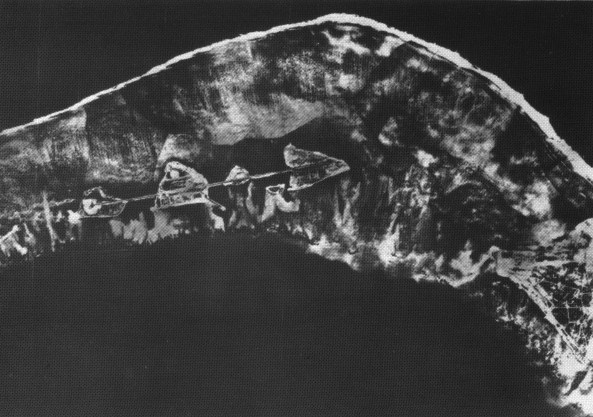
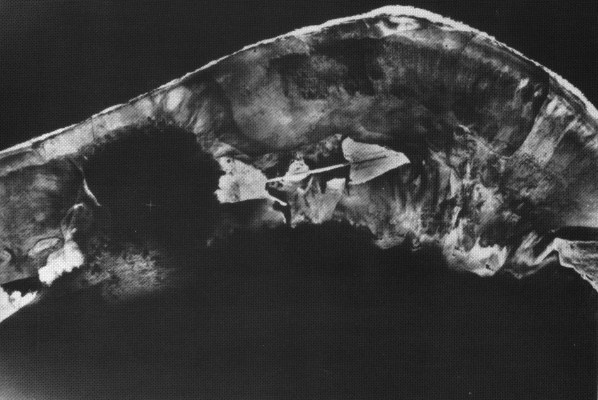
Ivy Mike, the pioneering device based on the Teller-Ulam design, was finally ready for detonation on the Enewetak Atoll (atoll = coral island encircling a lagoon) in the Pacific Ocean: Google Maps, crater (yes, the Elugelab [codenamed Flora] island in the the atoll [not the whole atoll whose radius is 15 km!] ceased to exist and was filled with water; before, after, source).

This device was one of the main reasons we have had peace for many and many decades; Edward Teller should have clearly gotten the Peace Nobel Prize that was jokingly given to the "European Union". How strong was the explosion? And how did the device work?


At the center of the device, there was a cylindrical rod of plutonium, the "sparkplug", that had the task to ignite the fusion reaction. It was surrounded by a natural five-ton uranium "tamper". The external side of the tamper was made of a mixture of lead and polyethylene and these sheets were sending X-rays from the primary to the secondary. The X-rays acted by their huge pressure and temperature.

All the lead, plutonium, and uranium stuff was there just to help the primary actor that was being tested – the cryogenic (=impractical for mobile bombs) liquid deuterium fuel at the very center (plus some tritium) – to get a bit excited and warmed up.

The whole active object, also named "sausage", was encapsulated in 25-30 centimeter thick steel. This whole toy was 54 tons heavy, 619 cm tall, and 203 cm in diameter. With other external components, Ivy Mike weighed over 80 tons (again, that's why it was impractical for mobile weapons). When it exploded, it produced 10-12 megatons of TNT but 77% came from the fission of the uranium "temper" (about 450 kg out of 4.5 tons of the uranium was "burned" releasing the equivalent of almost 8 megatons of TNT) but the remaining 23% may be attributed to fusion. The fireball was 5 km wide and the mushroom went to 17 km altitude in 90 seconds and 30 km in 150 seconds.

Note that 10 megatons of TNT is about 41.84 petajoules i.e. \(41.84\times 10^{15}\,{\rm J}\). Via \(E=mc^2\), that's equivalent to the complete destruction of 0.47 kilograms of matter. Take one-quarter of it (for fusion) and multiply it by 100 to see that about a kilogram of hydrogen was turned mostly into helium or new tritium (and other things).


Via Nuclear Secrecy.COM.

Alexander Ač told us about the energy stored in the otherwise mediocre Hurricane Sandy. His source states that Sandy "contained" – whatever it exactly meant – 0.222 petajoules of energy. It's only larger than the analogous numbers for other, stronger storms because Sandy's figure includes the wind energy from a larger area. If you know how to divide numbers, you can easily calculate that Ivy Mike released the same energy as 188 times the Hurricane Sandy. And it was pretty much produced by one right-wing physicist. That's a simple quantitative explanation why you shouldn't expect right-wing physicists to be overly impressed by the energy of the Hurricane Sandy. ;-)

But if the worshipers of the greenhouse effect and its hypothetical but indefensible effects on the weather events feel humiliated, and they surely should because they are, let me calm them down just a little bit. The research project initiated in 1951 that led to Ivy Mike had a nice name: the Greenhouse. :-D

(Yes, I needed Ivy Mike whose energy was equivalent to 750 Hiroshimas. Hiroshima wasn't enough to beat Sandy; it released about 1/4 of Sandy's energy. On the other hand, NYC rats are stronger than Sandy.)

The crater created by the blast was 3 km wide and 60 meters deep. 80 million tons of rocks were vaporized. The blast didn't proceed as expected – it was two times better i.e. stronger. One pilot who was supposed to pick some air samples died when he ran out of fuel. All elements including Einsteinium and Fermium were produced. A 50-kilometer vicinity of the atoll was substantially radioactively contaminated. You don't want to play with similar toys in the New York City; Sandy is just fine.

Harry Truman who politically supervised the research wasn't the only one. At that time, the Soviets were already working on something similar although their research was arguably not quite independent. Sakharov's Third Idea – the Slavic term for the Teller-Ulam design – got tested in 1955, three years after Ivy Mike (6 times lower yield than Ivy Mike). But already in 1953, one year after Ivy Mike, the USSR tested Joe 4 (0.4 megatons of TNT, 25 times smaller than Ivy Mike) based on a different "Sloika" philosophy. The strongest (thermonuclear or otherwise) man-made explosion ever (so far?) was the Tsar Bomba in 1961. At 57 megatons of TNT, it was 5 times stronger than Ivy Mike and 1,000 times stronger than Hurricane Sandy. Take it, Yankees and weather alarmists. ;-)

Hat tip: Technet.iDNES.cz


P.S.: Just a comment on the energy vs world energy consumption. The Ivy Mike blast may look very large and you could think that it would be great to use it as a generator of energy. But I mentioned that the blast released \(4\times 10^{16}\) joules of energy. It's a lot but the world's annual energy consumption is around \(4\times 10^{20}\) joules so you would have to tame 10,000 Ivy-Mike-like blasts a year to replace the existing sources of energy! But you could imagine it's doable. Forget about peaceful thermonuclear power plants and use a blast to raise a lot of matter to some altitude, or heat it, or something like that. 30 such Ivy Mike blasts a day may produce the electricity for the whole mankind. ;-)
Read More
Posted in climate, fusion, missile, science and society | No comments
Older Posts Home
View mobile version
Subscribe to: Posts (Atom)

Popular Posts

  • Likely: latest Atlantic hurricane-free date at least since 1941
    Originally posted on September 4th. Now, 5 days later, it seems that no currently active systems will grow to a hurricane so the records wi...
  • Amazon: 3D printers below $1,200
    When Howard Wolowitz bought a 3D printer to print figures of himself, Rajesh Koothrappali, Bernadette Rostenkowski-Wolowitz, and other heroe...
  • New iPhone likely to have a fingerprint scanner
    One year ago, Apple bought AuthenTec , a Prague-based security company ( 7 Husinecká Street ), for $356 million. One may now check the Czech...
  • A universal derivation of Bekenstein-Hawking entropy from topology change, ER-EPR
    I have been intrigued by topology change in quantum gravity, especially its Euclidean version, for 15 years or so. Since the beginning, I li...
  • Valtr Komárek: 1930-2013
    U.S.: As predicted and discussed on TRF exactly 3 months ago , Ernest Moniz became the new U.S. secretary of energy. Valtr Komárek died to...
  • Spanish train crash: quantifying the acceleration
    A tragically motivated homework problem in mechanics Chances are that you have already seen the dramatic video of the Wednesday Santiago de ...
  • An apologia for ideas from Hawking's BH bet concession
    In Summer 2004, Stephen Hawking conceded his and Kip Thorne's bet against John Preskill: Preskill was the only one among the three who s...
  • Confusions about the relationships of special relativity and general relativity
    Sabine Hossenfelder wrote about the confusions surrounding the relationship of Einstein's 1905 special theory of relativity and Einstei...
  • Anthony Watts' television channel
    Al Gore has a new TV competitor Last year, Al Gore's Climate Parody Day spent millions of dollars and attracted a few thousand viewers ...
  • A slower speed of light: MIT relativistic action game
    In the past, this blog focused on relativistic optical effects and visualizations of Einstein's theory: special relativity (download Re...

Categories

  • alternative physics (7)
  • astronomy (49)
  • biology (19)
  • cars (2)
  • climate (93)
  • colloquium (1)
  • computers (18)
  • Czechoslovakia (57)
  • Denmark (1)
  • education (7)
  • Europe (33)
  • everyday life (16)
  • experiments (83)
  • France (5)
  • freedom vs PC (11)
  • fusion (3)
  • games (2)
  • geology (5)
  • guest (6)
  • heliophysics (2)
  • IQ (1)
  • Kyoto (5)
  • landscape (9)
  • LHC (40)
  • markets (40)
  • mathematics (37)
  • Middle East (12)
  • missile (9)
  • murders (4)
  • music (3)
  • philosophy of science (73)
  • politics (98)
  • religion (10)
  • Russia (5)
  • science and society (217)
  • sports (5)
  • string vacua and phenomenology (114)
  • stringy quantum gravity (90)
  • TBBT (5)
  • textbooks (2)
  • TV (8)
  • video (22)
  • weather records (30)

Blog Archive

  • ▼  2013 (341)
    • ▼  September (14)
      • Likely: latest Atlantic hurricane-free date at lea...
      • Democrats of Europe, wake up!
      • Confusions about the relationships of special rela...
      • Yo-yo banned in Syria
      • Snowden: Internet encryption useless against eyes ...
      • A universal derivation of Bekenstein-Hawking entro...
      • Nathaniel Craig's State of the SUSY Union address
      • Did soot melt glaciers in the 19th century?
      • 16 out of half a billion: elite Calabi-Yau manifol...
      • Lev Pontryagin: 105th anniversary
      • The 50 to 1 project
      • Ukrainian ex-porn star wins legal residence in Cze...
      • An apologia for ideas from Hawking's BH bet conces...
      • Feminists demand gender quotas for bodies buried i...
    • ►  August (42)
    • ►  July (36)
    • ►  June (39)
    • ►  May (38)
    • ►  April (41)
    • ►  March (44)
    • ►  February (41)
    • ►  January (46)
  • ►  2012 (159)
    • ►  December (37)
    • ►  November (50)
    • ►  October (53)
    • ►  September (19)
Powered by Blogger.

About Me

Unknown
View my complete profile